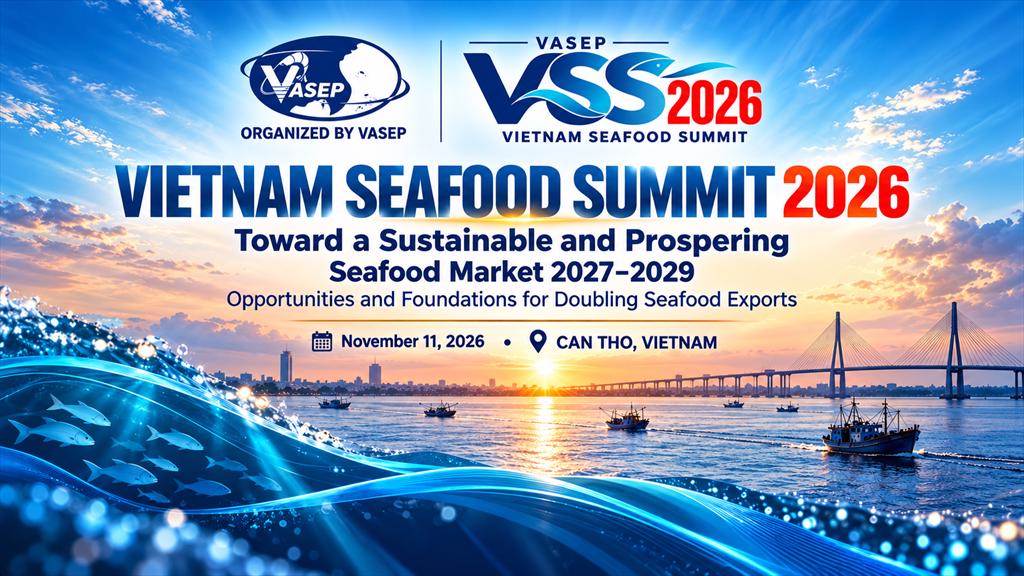
On November 11, 2026, in Can Tho, the Vietnam Association of Seafood Exporters and Producers (VASEP) will organize VIETNAM SEAFOOD SUMMIT 2026 (VSS 2026) under the theme “Seafood Market Outlook 2027–2029: Opportunities and Headroom for Double-Digit Export Growth.” This marks the first time VASEP has organized an event in the format of a seafood industry summit, with the aim of establishing an annual forum that connects seafood business leaders, buyers, supply chain companies, market experts, and policymakers.
Businesses need to look beyond short-term market Fluctuations
Recent years have shown how rapidly global seafood markets can change. Supply and demand, prices, inventories, purchasing power, trade policies, and requirements imposed by importing markets can all directly affect businesses’ orders, costs, and profit margins.
Identifying supply-and-demand trends, market opportunities, and potential risks at an early stage has therefore become increasingly important in production and business planning.
Against this backdrop, VSS 2026 will look beyond annual export performance and take a broader view of the 2027–2029 period. How will raw material supplies evolve? Which seafood sectors still have room to grow? Which markets could generate new momentum? What risks should businesses prepare for in advance? And how are buyer requirements changing?
This is the distinction that VIETNAM SEAFOOD SUMMIT aims to deliver: moving from market information to strategic insights, and from forecasts to business action.
Five sessions addressing businesses’ key concerns
VSS 2026 features five in-depth sessions covering export markets, buyer expectations, the domestic market, and solutions across the entire value chain.
The summit will open with an outlook for seafood sectors in 2027–2029, addressing issues closely linked to business operations: orders, raw material supplies, production costs, profit margins, capacity utilization, inventories, and competitive pressure, as well as opportunities arising from new products, value-added processing, and by-product utilization.
Another issue increasingly affecting exports is the impact of tariffs, protectionism, and trade defense measures. VSS 2026 will dedicate a session to identifying shifts in global trade flows, risks in the United States, and requirements and barriers in markets such as China, the European Union, the United Kingdom, and Japan.
In particular, rather than viewing the market solely from the seller’s perspective, the program will ask: “What will buyers need in the years ahead?” Three market scenarios for 2027–2029 will be analyzed alongside signals relating to demand, prices, supply, orders, product specifications, traceability, and sustainability. These insights will help businesses make better-informed decisions on raw materials, production, sales, and cash flow.
VSS 2026 will also broaden the discussion to Vietnam’s domestic market, examining changing consumer behavior and retailers’ expectations regarding products, pricing, packaging, convenience, traceability, delivery, and the ability to maintain product presence on store shelves and online platforms.
The program will conclude with solutions across the entire value chain, covering raw materials, seed stock, feed, technology, automation, logistics, credit, certification, sustainability, the circular economy, and the commercialization of by-products. These factors are directly linked to the industry’s efforts to increase productivity and reduce costs.
The summit’s value lies in practical, real-world perspectives
One of VASEP’s key priorities for VSS 2026 is the direct participation of business leaders, experts, policymakers, and companies across the seafood supply chain. Their involvement will ensure that discussions are informed not only by data and policy considerations but also by the realities of orders, production, market conditions, and business operations.
The summit is therefore designed not only to provide information supporting business plans for 2027 and medium-term strategies through 2029, but also to create opportunities for companies to exchange experience, share perspectives, connect with partners, and explore new avenues for cooperation.
With more than 300 delegates and 25 speakers, including business leaders and experts, Vietnam Seafood Summit 2026 aims to become a meaningful platform for dialogue, enabling the business community to assess major market developments and identify new growth opportunities for Vietnam’s seafood industry.
Vietnam Seafood Summit 2026 will take place from 08:30 to 16:30 on Wednesday, November 11, 2026, at Muong Thanh Luxury Can Tho Hotel, Cai Khe Ward, Can Tho City, Vietnam. Businesses are invited to register by October 26, 2026.
For the full program and further information, visit: vietnamseafoodsummit.com
Registration and sponsorship inquiries: Ms. Nguyen Hai Yen – (+84) 85 858 2626 – nguyenyen@vasep.com.vn
Media inquiries: Ms. Van Ha – (+84) 912 286 878 – vanha@vasep.com.vn
(vasep.com.vn) Markets are changing faster, buyer requirements are becoming more demanding, and trade barriers are growing increasingly complex. In this environment, seafood businesses need more than an understanding of current market conditions. They need a longer-term perspective to answer a critical question: Where will growth opportunities come from in 2027–2029, and what should businesses do now to prepare? This is one of the key reasons why VASEP is organizing Vietnam Seafood Summit 2026.
(vasep.com.vn) In the first eight months of 2026, Vietnam’s pangasius exports to the Middle East reached US$113 million, up 7% year on year from the same period in 2025. Growth has become more pronounced in recent months. In August alone, exports to the region totaled US$20 million, an increase of 24%. This indicates that demand for Vietnamese pangasius in the Middle East is gradually recovering after a slowdown in March, although the pace of recovery varies across markets.
(vasep.com.vn) China’s shrimp imports continued to grow strongly in 2026, while Vietnam’s shrimp exports to the market also recorded notable growth. However, behind these positive figures lie two distinct trends: Chinese consumption is growing more slowly than imports, and lobster accounts for a substantial share of Vietnam’s shrimp exports to China, making its product mix significantly different from those of Ecuador and India. Exporters therefore need to assess each segment carefully to understand the opportunities and risks.
(vasep.com.vn) Changing markets, shifting buyer demand, and increasingly complex trade barriers are raising a key question for Vietnam’s seafood industry: Where will the new growth opportunities lie in 2027–2029?
(seafood.vasep.com.vn) As of the end of August 2026, Vietnam’s tilapia exports to the United States reached $21 million, representing a steep 48% year-over-year decline and accounting for 23% of the country's total tilapia export turnover. Frozen fillets accounted for 78% with the remainder consisting of whole frozen tilapia and frozen cuts.
(seafood.vasep.com.vn) After a volatile first half of the year, Vietnam’s pangasius exports to Brazil registered robust growth in July and August 2026. In August alone, export turnover reached $19 million, surging 73% compared to the same period in 2025. Cumulatively for the first eight months, total export value reached $124 million, reflecting an 8% year-over-year increase.
(seafood.vasep.com.vn) Besides modifying their boats, many fishermen in Dak Lak province are making efforts to venture out to sea to harvest seafood during the rough sea season.
(seafood.vasep.com.vn) At the Responsible Seafood Summit and TCRS Shrimp Summit 2026, organized by the GSA (Global Seafood Alliance) in Bangkok, Thailand, the conversation about the future of the shrimp industry began with one of its most important foundations: seedstock quality.
(seafood.vasep.com.vn) In the first eight months of 2026, Vietnam’s tuna exports to Lithuania surpassed $14 million, up 8% year on year. While the increase remains modest, it is notable given the continued pressure on Vietnamese tuna exports to the EU as a whole. More importantly, export turnover to Lithuania has shown a clearer recovery in recent months, making the market a destination worth monitoring for Vietnamese businesses in Europe.
(seafood.vasep.com.vn) Vietnam’s squid and octopus exports exceeded $527 million in the first eight months of 2026, marking a 15% year-on-year increase. This growth is particularly notable given the strong baseline established in 2025, when export turnover for the same period reached $458 million, a 13% rise from 2024.
VASEP - HIỆP HỘI CHẾ BIẾN VÀ XUẤT KHẨU THỦY SẢN VIỆT NAM
Chịu trách nhiệm: Ông Nguyễn Hoài Nam - Phó Tổng thư ký Hiệp hội
Đơn vị vận hành trang tin điện tử: Trung tâm VASEP.PRO
Trưởng Ban Biên tập: Bà Phùng Thị Kim Thu
Giấy phép hoạt động Trang thông tin điện tử tổng hợp số 138/GP-TTĐT, ngày 01/10/2013 của Bộ Thông tin và Truyền thông
Tel: (+84 24) 3.7715055 – (ext.203); email: kimthu@vasep.com.vn
Trụ sở: Số 7 đường Nguyễn Quý Cảnh, Phường An Phú, Quận 2, Tp.Hồ Chí Minh
Tel: (+84) 28.628.10430 - Fax: (+84) 28.628.10437 - Email: vasephcm@vasep.com.vn
VPĐD: số 10, Nguyễn Công Hoan, Ngọc Khánh, Ba Đình, Hà Nội
Tel: (+84 24) 3.7715055 - Fax: (+84 24) 37715084 - Email: vasephn@vasep.com.vn