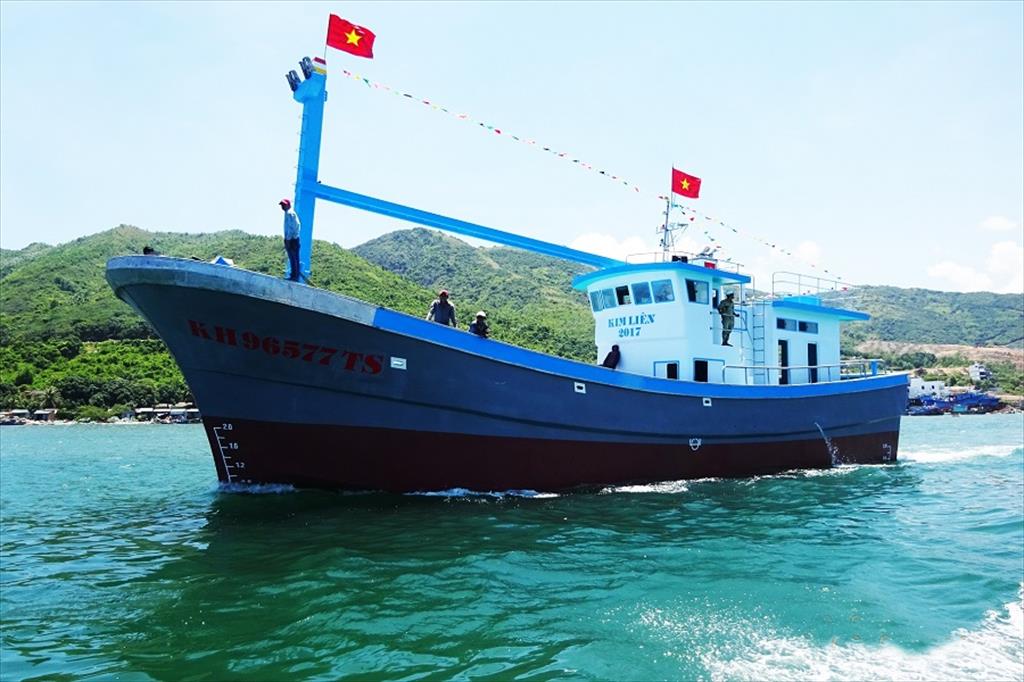
To combat illegal, unreported, and unregulated fishing (IUU fishing), localities should continue to promote the effective implementation of the Fisheries Law, overcoming the shortcomings in control of fishing vessels entering and leaving ports; enhance the traceability of seafood, prevent and promptly and effectively handle fishing vessels that violate or show signs of IUU fishing violation to remove the yellow cards.
Traceability of seafood products faced many difficulties
Over the past few years, fishing vessels of the coastal provinces and cities in Vietnam have mainly sold products to middlemen, the volume of landing at the designated fishing ports has not been much. Nevertheless, when comparing the history of activities at sea through fishing vessel monitoring with fishing logbook, most of them "do not match", so it is impossible to confirm seafood materials for businesses. Therefore, enterprises cannot prove that the exported products are captured from legal fishing.
What's more, due to the specific characteristics of the fishing work, mainly continuously operating at sea, so recording the fishing voyage of the past time has faced many difficulties. Meanwhile, the request of the European Commission (EC) on the traceability of seafood is very strict in the process of considering lifting the "yellow card" for Vietnamese seafood.
The major seafood import markets in the world, especially the EU, the US, Japan, and South Korea, all have strict requirements for quality control and traceability. Therefore, the Ministry of Agriculture and Rural Development (MARD) has determined that the implementation of solutions to traceability of seafood is very difficult, but it must be determined to carry out.
Determined to achieve the result
To overcome the EC's IUU yellow card warning, in recent years, coastal localities across the country have drastically implemented the fishing certification and traceability of fishery products, to meet the EC's recommendations.
Ca Mau province currently has over 4,900 registered fishing vessels with a total capacity of 582,658KW. In which, the number of vessels with the length under 12 meters is more than 1,880 pcs with a total capacity of 39,411KW; the vessel with the length from 12m to less than 15m is 1,387 pcs with a total capacity of 141,979KW; The vessel with the length of 15m or beyond is 1,690 pcs with a total capacity of 401,268KW.
Mr. Tran Van Truong, the captain of a fishing boat living in Song Doc town, Tran Van Thoi district, said: “We need to follow the regulations of the Law, but this recording takes a lot of time and effort. On the boat, most of the crew members are on fishing duty and have little time to rest, so it is very difficult to record the detailed type of fish, the weight of the catch ... I propose that there should be a support mechanism, guidance to facilitate the vessel and the captain in the implementation of this work ".
Deputy Director of the Department of Agriculture and Rural Development of Ca Mau Province - Mr. Chau Cong Bang said: "In the coming time, the Department of Agriculture and Rural Development of the province continues to seriously implement the direction and guidelines of the Provincial People's Committee, resolutely not allow to go to the sea for logistic fishing vessel and exploited aquatic resource fishing vessels with the maximum length of 15m or more that do not have the competent authorities' records of checking in and out of ports.
Strengthen the grasp of the area, well control the fishing vessels leaving and entering the seaport to submit to the Border Control Station and docking at and leaving designated fishing ports, comparing monthly data among relevant forces;
Timely inform each other about cases of fishing vessels that do not have, do not record, or do not record fully or incorrectly in fishing logs; exploiting the wrong area; not docked at a fishing port named on the list of designated fishing ports; fishing vessel registration and registration expired; relevant handling forms.
According to the regulations of the authorities, the vessel owner must give notice 2 hours before the vessel leaves or docked and must present all documents, papers, and information to the competent forces to check. If the conditions are satisfied, they will be stamped on the confirmation paper.
On the other hand, according to Article 4, Circular 21/2018/TT- of the Ministry of Agriculture and Rural Development regulating certification of fishery origin, captains of fishing vessels with a maximum length of 12 meters or more are required to record logbooks and submit to the fishing port management organization within 24 hours after the vessel has finished loading and unloading seafood through the port.
For vessels with a maximum length from 6 to less than 12 meters, the captain must record a catch report and submit it to the fishing port management organization periodically once a week.
(vasep.com.vn) Markets are changing faster, buyer requirements are becoming more demanding, and trade barriers are growing increasingly complex. In this environment, seafood businesses need more than an understanding of current market conditions. They need a longer-term perspective to answer a critical question: Where will growth opportunities come from in 2027–2029, and what should businesses do now to prepare? This is one of the key reasons why VASEP is organizing Vietnam Seafood Summit 2026.
(vasep.com.vn) In the first eight months of 2026, Vietnam’s pangasius exports to the Middle East reached US$113 million, up 7% year on year from the same period in 2025. Growth has become more pronounced in recent months. In August alone, exports to the region totaled US$20 million, an increase of 24%. This indicates that demand for Vietnamese pangasius in the Middle East is gradually recovering after a slowdown in March, although the pace of recovery varies across markets.
(vasep.com.vn) China’s shrimp imports continued to grow strongly in 2026, while Vietnam’s shrimp exports to the market also recorded notable growth. However, behind these positive figures lie two distinct trends: Chinese consumption is growing more slowly than imports, and lobster accounts for a substantial share of Vietnam’s shrimp exports to China, making its product mix significantly different from those of Ecuador and India. Exporters therefore need to assess each segment carefully to understand the opportunities and risks.
(vasep.com.vn) Changing markets, shifting buyer demand, and increasingly complex trade barriers are raising a key question for Vietnam’s seafood industry: Where will the new growth opportunities lie in 2027–2029?
(seafood.vasep.com.vn) As of the end of August 2026, Vietnam’s tilapia exports to the United States reached $21 million, representing a steep 48% year-over-year decline and accounting for 23% of the country's total tilapia export turnover. Frozen fillets accounted for 78% with the remainder consisting of whole frozen tilapia and frozen cuts.
(seafood.vasep.com.vn) After a volatile first half of the year, Vietnam’s pangasius exports to Brazil registered robust growth in July and August 2026. In August alone, export turnover reached $19 million, surging 73% compared to the same period in 2025. Cumulatively for the first eight months, total export value reached $124 million, reflecting an 8% year-over-year increase.
(seafood.vasep.com.vn) Besides modifying their boats, many fishermen in Dak Lak province are making efforts to venture out to sea to harvest seafood during the rough sea season.
(seafood.vasep.com.vn) At the Responsible Seafood Summit and TCRS Shrimp Summit 2026, organized by the GSA (Global Seafood Alliance) in Bangkok, Thailand, the conversation about the future of the shrimp industry began with one of its most important foundations: seedstock quality.
(seafood.vasep.com.vn) In the first eight months of 2026, Vietnam’s tuna exports to Lithuania surpassed $14 million, up 8% year on year. While the increase remains modest, it is notable given the continued pressure on Vietnamese tuna exports to the EU as a whole. More importantly, export turnover to Lithuania has shown a clearer recovery in recent months, making the market a destination worth monitoring for Vietnamese businesses in Europe.
(seafood.vasep.com.vn) Vietnam’s squid and octopus exports exceeded $527 million in the first eight months of 2026, marking a 15% year-on-year increase. This growth is particularly notable given the strong baseline established in 2025, when export turnover for the same period reached $458 million, a 13% rise from 2024.
VASEP - HIỆP HỘI CHẾ BIẾN VÀ XUẤT KHẨU THỦY SẢN VIỆT NAM
Chịu trách nhiệm: Ông Nguyễn Hoài Nam - Phó Tổng thư ký Hiệp hội
Đơn vị vận hành trang tin điện tử: Trung tâm VASEP.PRO
Trưởng Ban Biên tập: Bà Phùng Thị Kim Thu
Giấy phép hoạt động Trang thông tin điện tử tổng hợp số 138/GP-TTĐT, ngày 01/10/2013 của Bộ Thông tin và Truyền thông
Tel: (+84 24) 3.7715055 – (ext.203); email: kimthu@vasep.com.vn
Trụ sở: Số 7 đường Nguyễn Quý Cảnh, Phường An Phú, Quận 2, Tp.Hồ Chí Minh
Tel: (+84) 28.628.10430 - Fax: (+84) 28.628.10437 - Email: vasephcm@vasep.com.vn
VPĐD: số 10, Nguyễn Công Hoan, Ngọc Khánh, Ba Đình, Hà Nội
Tel: (+84 24) 3.7715055 - Fax: (+84 24) 37715084 - Email: vasephn@vasep.com.vn