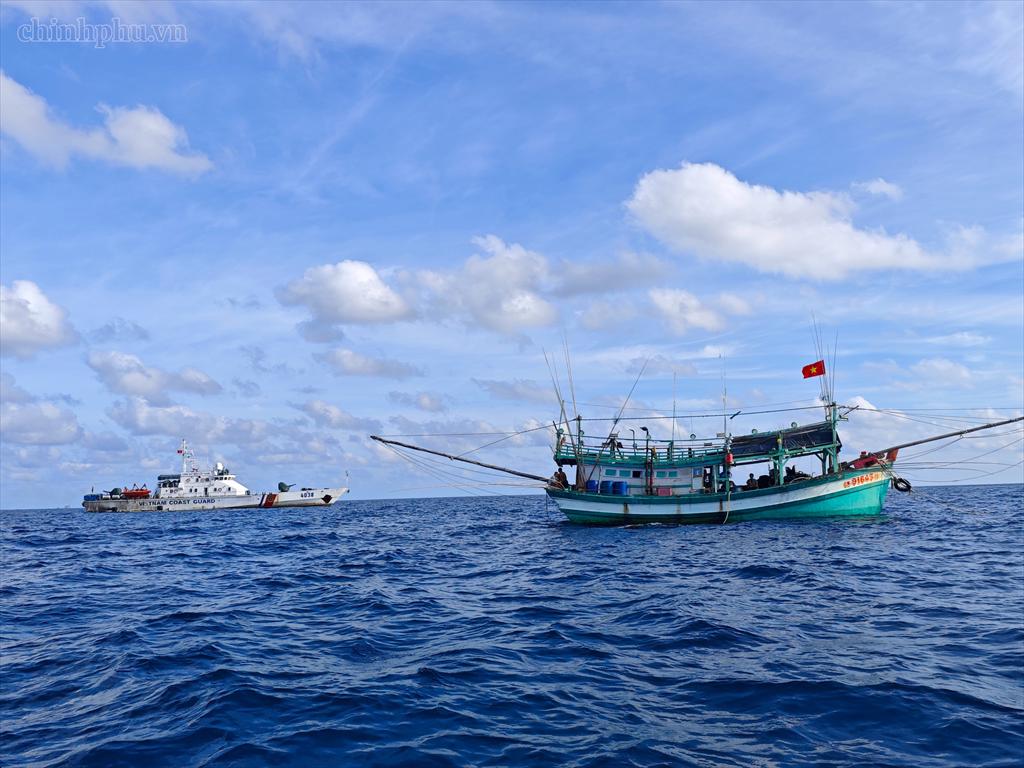
Each fishing trip now requires more thorough preparation, from machinery and equipment to communication and continuous monitoring of weather conditions, to ensure safety, efficient fishing, and to combat illegal, unreported, and unregulated (IUU) fishing.
Currently, rising costs per fishing trip, coupled with declining catches, are forcing fishermen to innovate their fishing methods. In Dak Lak province, many boat owners have upgraded their vessels, invested in modern equipment, and increased capacity to improve fishing efficiency while complying with regulations against IUU (Illegal, Unreported, and Unregulated) fishing. Technology is also becoming a solution to help fishermen be more proactive in the face of unpredictable changes at sea.
Before heading out to sea during the stormy season, fisherman Pham Duy Cuong (Tuy Hoa ward, Dak Lak province) checks all the equipment on his boat. Every system, from machinery and radios to fishing and communication equipment, is carefully inspected. According to Mr. Cuong, having accurate weather information is especially important during rough seas. Fishermen still work at sea, but this season often brings storms and high risks. Therefore, fishermen maintain contact with the navy to receive weather updates and identify dangerous areas to avoid.
Fisherman Nguyen Be (Phu Yen ward, Dak Lak province) shared that he and many local people have been making a living from the sea for generations. He also intends to continue the profession with his children, raising capital to buy larger boats to continue venturing out to sea. However, the fishing industry is currently facing many difficulties due to market fluctuations. Fishermen are requesting that the government continue to provide subsidies for fuel and also implement measures to increase fish prices so that fishermen can continue to fish and venture further offshore.
Phu Yen ward currently has over 200 fishing vessels specializing in offshore fishing. In the context of the fisheries sector's strong shift towards responsible fishing practices, upgrading these vessels is also linked to the requirement of strictly adhering to regulations on combating IUU (Illegal, Unreported, and Unregulated) fishing. To ensure safe fishing trips, the local authorities are also strengthening monitoring, information sharing, and implementing disaster response plans, especially during periods of complex weather patterns.
Mr. Nguyen Thai Thinh, Vice Chairman of the People's Committee of Phu Yen Ward, said that the locality had developed plans and measures for disaster prevention and control since the beginning of the year. As a coastal ward in the eastern part of the province, disaster response focuses on solutions to ensure the safety of lives and property for fishermen; in particular, fishermen maintain close coordination with functional agencies regarding weather conditions while fishing at sea. When boats return to port, mooring is also carefully considered to ensure safety.
During the stormy season, each fishing trip is a challenging journey. Proactively inspecting equipment, equipping themselves with coping skills, and regularly updating weather information will help fishermen minimize risks, stay at sea with confidence, and contribute to preserving fishing grounds. In addition, fishermen will also have their awareness raised regarding combating IUU (Illegal, Unreported, and Unregulated) fishing, contributing to positive changes in the fisheries sector.
Currently, Dak Lak province has nearly 2,600 fishing vessels registered in the national database system; of which, nearly 690 vessels with a length of 15 meters or more, which are required to install vessel monitoring systems (VMS), have completed the installation, achieving a 100% rate. 100% of fishing vessels have been marked and registered according to regulations. From August to October 2026, the province will focus on implementing solutions to thoroughly address the recommendations on combating IUU fishing before the EC inspection team arrives.
According to Mr. Nguyen Thai Hoa, Deputy Director of the Department of Agriculture and Environment of Dak Lak province, in recent times, the province has decisively and comprehensively implemented many solutions to prevent and combat IUU fishing; in particular, the management of the fishing fleet has been strengthened. The rate of issuing fishing vessel registration certificates, technical safety certificates, and fishing licenses is always given attention and implemented correctly by vessel owners. The control of fishing vessels entering and leaving ports and the traceability of seafood are regularly maintained.
The regular presence of the Fisheries Surveillance Force and Border Guard in the sea areas under the province's management has also contributed to raising awareness of law compliance and ensuring full adherence to regulations related to fishing vessels, crew members, and maritime navigation among fishermen operating at sea, thus protecting aquatic resources. Coastal communities are increasingly complying with legal regulations on combating IUU fishing.
(vasep.com.vn) Markets are changing faster, buyer requirements are becoming more demanding, and trade barriers are growing increasingly complex. In this environment, seafood businesses need more than an understanding of current market conditions. They need a longer-term perspective to answer a critical question: Where will growth opportunities come from in 2027–2029, and what should businesses do now to prepare? This is one of the key reasons why VASEP is organizing Vietnam Seafood Summit 2026.
(vasep.com.vn) In the first eight months of 2026, Vietnam’s pangasius exports to the Middle East reached US$113 million, up 7% year on year from the same period in 2025. Growth has become more pronounced in recent months. In August alone, exports to the region totaled US$20 million, an increase of 24%. This indicates that demand for Vietnamese pangasius in the Middle East is gradually recovering after a slowdown in March, although the pace of recovery varies across markets.
(vasep.com.vn) China’s shrimp imports continued to grow strongly in 2026, while Vietnam’s shrimp exports to the market also recorded notable growth. However, behind these positive figures lie two distinct trends: Chinese consumption is growing more slowly than imports, and lobster accounts for a substantial share of Vietnam’s shrimp exports to China, making its product mix significantly different from those of Ecuador and India. Exporters therefore need to assess each segment carefully to understand the opportunities and risks.
(vasep.com.vn) Changing markets, shifting buyer demand, and increasingly complex trade barriers are raising a key question for Vietnam’s seafood industry: Where will the new growth opportunities lie in 2027–2029?
(seafood.vasep.com.vn) As of the end of August 2026, Vietnam’s tilapia exports to the United States reached $21 million, representing a steep 48% year-over-year decline and accounting for 23% of the country's total tilapia export turnover. Frozen fillets accounted for 78% with the remainder consisting of whole frozen tilapia and frozen cuts.
(seafood.vasep.com.vn) After a volatile first half of the year, Vietnam’s pangasius exports to Brazil registered robust growth in July and August 2026. In August alone, export turnover reached $19 million, surging 73% compared to the same period in 2025. Cumulatively for the first eight months, total export value reached $124 million, reflecting an 8% year-over-year increase.
(seafood.vasep.com.vn) Besides modifying their boats, many fishermen in Dak Lak province are making efforts to venture out to sea to harvest seafood during the rough sea season.
(seafood.vasep.com.vn) At the Responsible Seafood Summit and TCRS Shrimp Summit 2026, organized by the GSA (Global Seafood Alliance) in Bangkok, Thailand, the conversation about the future of the shrimp industry began with one of its most important foundations: seedstock quality.
(seafood.vasep.com.vn) In the first eight months of 2026, Vietnam’s tuna exports to Lithuania surpassed $14 million, up 8% year on year. While the increase remains modest, it is notable given the continued pressure on Vietnamese tuna exports to the EU as a whole. More importantly, export turnover to Lithuania has shown a clearer recovery in recent months, making the market a destination worth monitoring for Vietnamese businesses in Europe.
(seafood.vasep.com.vn) Vietnam’s squid and octopus exports exceeded $527 million in the first eight months of 2026, marking a 15% year-on-year increase. This growth is particularly notable given the strong baseline established in 2025, when export turnover for the same period reached $458 million, a 13% rise from 2024.
VASEP - HIỆP HỘI CHẾ BIẾN VÀ XUẤT KHẨU THỦY SẢN VIỆT NAM
Chịu trách nhiệm: Ông Nguyễn Hoài Nam - Phó Tổng thư ký Hiệp hội
Đơn vị vận hành trang tin điện tử: Trung tâm VASEP.PRO
Trưởng Ban Biên tập: Bà Phùng Thị Kim Thu
Giấy phép hoạt động Trang thông tin điện tử tổng hợp số 138/GP-TTĐT, ngày 01/10/2013 của Bộ Thông tin và Truyền thông
Tel: (+84 24) 3.7715055 – (ext.203); email: kimthu@vasep.com.vn
Trụ sở: Số 7 đường Nguyễn Quý Cảnh, Phường An Phú, Quận 2, Tp.Hồ Chí Minh
Tel: (+84) 28.628.10430 - Fax: (+84) 28.628.10437 - Email: vasephcm@vasep.com.vn
VPĐD: số 10, Nguyễn Công Hoan, Ngọc Khánh, Ba Đình, Hà Nội
Tel: (+84 24) 3.7715055 - Fax: (+84 24) 37715084 - Email: vasephn@vasep.com.vn