From 2018 to 2022, in the top 6 import markets, only Australia has continuously increased seafood import turnover from Vietnam. From 197 million USD in 2018 seafood exports to Australia increased by 85% to 365 million USD in 2022. The proportion of the Australian market therefore also increased from 2.2% to 3.3% of Vietnam's total seafood exports.
The opening of the Australian market together with tariff incentives from the CPTPP free trade agreement has brought about an opportunity to increase Vietnam's seafood exports to Australia in recent years.
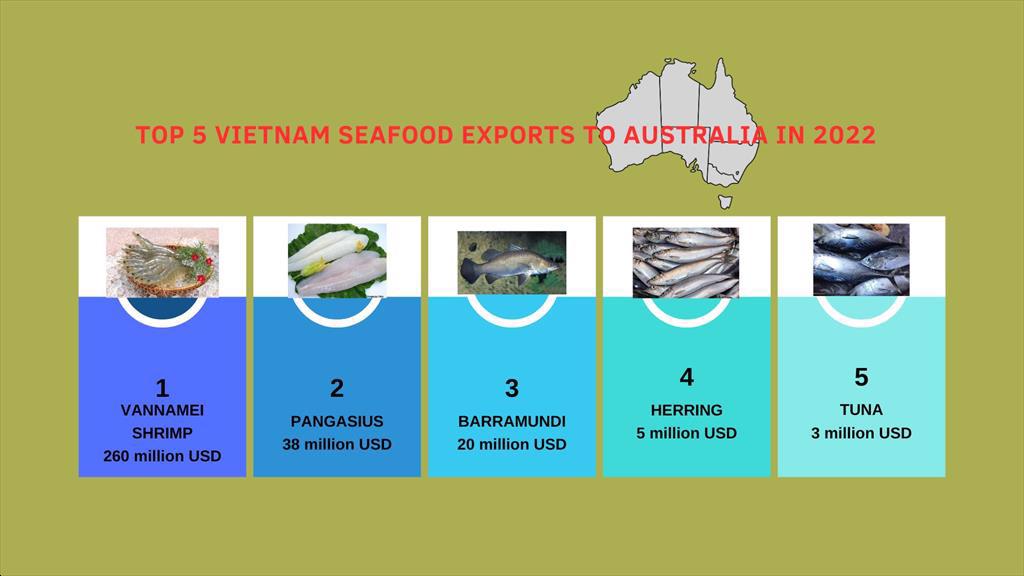
Breaking through and accounting for the largest proportion of products exported to Australia after 4 years is vannamei shrimp. In 2022, the export of this product to Australia reached 259.5 million USD, up 171% compared to 112 million USD in 2018, before the CPTPP agreement took effect.
Shrimp revenue accounted for 71% of Vietnam's seafood export value to Australia in 2022, compared to 49% in 2018.In contrast, pangasius exports to Australia decreased from 24% to 10%. From 2018 - 2022, Vietnam's pangasius exports to Australia decreased by 18%, from $47 million to $38 million.
Among the top 3 seafood products exported to Australia, barramundi accounts for 6% of export sales with a value of nearly 21 million USD in 2022. Vietnam's barramundi exports are mainly farmed products of Australis company in Vietnam.
Vietnam is holding the No. 1 position in the Australian seafood market, accounting for 23% of Austria's seafood imports in 2022. This proportion is much higher than 13% of 5 years ago, showing a strong breakthrough of Vietnam's seafood products in Australia, thanks to the good trade cooperation relationship and FTA agreements with Australia, including AANZFTA, CPTPP and RCEP.
Especially, after the CPTPP agreement came to effect, seafood products such as shrimp, pangasius and marine products imported from Vietnam into Australia has enjoyed a tax rate of 0%.
In the first quarter of 2023, Vietnam's seafood exports to Australia reached 63 million USD, down 32% over the same period last year. In which, whiteleg shrimp exports decreased by 34%, pangasius exports decreased by 26%, seabass decreased by 34%...
In the context of 2023, the Australian market is also not immune to the impact of the food inflation spiral, causing consumption to be affected and reduced.
Hopefully, after the Australian diplomatic delegation’s visit to Vietnam, seafood exports from Vietnam to Australia will rise to a new high, whereby not only shrimp but also pangasius and seafood to this market will grow stronger.
(seafood.vasep.com.vn) Marking 27 years of supporting Vietnam’s seafood industry, the Vietnam International Seafood Exhibition (VIETFISH 2026) will officially return from August 19–21, 2026, at the Saigon Exhibition and Convention Center (SECC) in Ho Chi Minh City, on its largest scale ever. Under the core theme “Innovation – Sustainability,” the event promises to provide a comprehensive picture of the transformation of Vietnam’s seafood industry toward greater value addition and sustainable development.
(seafood.vasep.com.vn) With less than three weeks remaining, the Vietnam Fisheries International Exhibition – Vietfish 2026 will officially take place from August 19–21, 2026, at the Saigon Exhibition and Convention Center (SECC) in Ho Chi Minh City. Under the theme "Innovation – Sustainability," Vietfish 2026 will provide a comprehensive networking platform for seafood businesses, buyers, distributors, industry experts, government agencies, and domestic and international visitors.
(vasep.com.vn) As part of the Vietnam Fisheries International Exhibition – Vietfish 2026, the technical seminar “Green and Sustainable Technology Solutions for the Aquaculture and Seafood Processing Value Chain” will take place from 09:30 to 11:45 on August 20, 2026, at Convention Room B, Level 2, SECC, Ho Chi Minh City. The seminar is jointly organized by VASEP, the Department of Fisheries and Fisheries Surveillance, and the Royal Norwegian Embassy in Vietnam, focusing on technological innovation and sustainable transformation across Vietnam’s seafood value chain.
(seafood.vasep.com.vn) Market fluctuations, rising production costs, and increasingly stringent requirements from export markets are placing growing pressure on the shrimp industry. In response, Vinh Long Province is promoting high-tech shrimp farming integrated with production–consumption value chains to improve efficiency, reduce risks, and enhance the industry's value.
(seafood.vasep.com.vn) Vietnam's tilapia exports to Japan posted strong growth in the first half of 2026, while a promising new trend has emerged in the value-added product segment. Notably, Vietnamese tilapia fillets have been exported to Japan for use in sushi and sashimi, creating new opportunities to enhance the value of the industry in one of the world's most demanding seafood markets.
(seafood.vasep.com.vn) After a relatively sluggish first quarter, Vietnam's exports of fish cakes and surimi showed a clearer recovery in the second quarter, particularly in June. Export value in the first six months of 2026 reached USD 148 million, down 2% year on year. However, the newly imposed 12.5% additional U.S. tariff on Vietnamese goods, intensifying competition in Northeast Asia, and increasingly stringent traceability requirements in the EU are making the outlook for the second half of the year more uncertain.
(seafood.vasep.com.vn) In June 2026, Vietnam's shrimp exports reached nearly USD 458 million, up 24% year-on-year. In the first six months of 2026, export value totaled USD 2.35 billion, an increase of 14.2% compared with the same period last year. Growth was driven mainly by the Chinese market and the strong performance of lobster exports, while shrimp exports continued to face pressure from U.S. tariffs and rising logistics costs.
(seafood.vasep.com.vn) As part of Vietfish 2026, the Hosted Buyer Program is designed as a specialized B2B matchmaking initiative for selected international buyers, providing opportunities to meet directly with Vietnamese seafood exporters, gain the latest market insights, and experience Vietnam's seafood supply chain firsthand.
(seafood.vasep.com.vn) A project titled "Sustainable Shrimp Industry Governance" has been launched in Ca Mau Province with the aim of supporting the transition of the province's shrimp industry toward higher quality, lower emissions, stronger governance capacity, improved supply chain traceability, and the development of a sustainable shrimp brand that meets the increasingly stringent requirements of export markets.
(seafood.vasep.com.vn) Khanh Hoa Provincial Agricultural Extension Center, in collaboration with the Northern Center for Marine Aquaculture Research and the Van Hung Public Service Center, recently organized a training course on disease-free golden pompano seed production. The program is part of a National Agricultural Extension Project aimed at developing industrial-scale seed production models to support sustainable marine aquaculture.
VASEP - HIỆP HỘI CHẾ BIẾN VÀ XUẤT KHẨU THỦY SẢN VIỆT NAM
Chịu trách nhiệm: Ông Nguyễn Hoài Nam - Phó Tổng thư ký Hiệp hội
Đơn vị vận hành trang tin điện tử: Trung tâm VASEP.PRO
Trưởng Ban Biên tập: Bà Phùng Thị Kim Thu
Giấy phép hoạt động Trang thông tin điện tử tổng hợp số 138/GP-TTĐT, ngày 01/10/2013 của Bộ Thông tin và Truyền thông
Tel: (+84 24) 3.7715055 – (ext.203); email: kimthu@vasep.com.vn
Trụ sở: Số 7 đường Nguyễn Quý Cảnh, Phường An Phú, Quận 2, Tp.Hồ Chí Minh
Tel: (+84) 28.628.10430 - Fax: (+84) 28.628.10437 - Email: vasephcm@vasep.com.vn
VPĐD: số 10, Nguyễn Công Hoan, Ngọc Khánh, Ba Đình, Hà Nội
Tel: (+84 24) 3.7715055 - Fax: (+84 24) 37715084 - Email: vasephn@vasep.com.vn