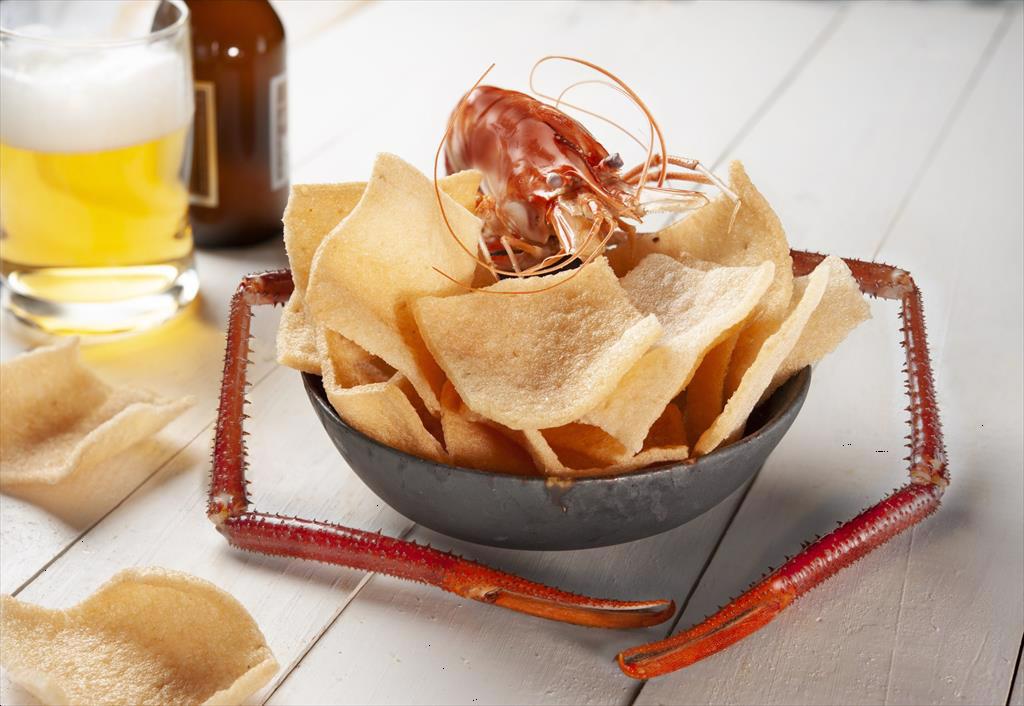
Few would expect that the humble and familiar shrimp chip - long beloved in Vietnamese households - has gained international acclaim, bringing in hundreds of billions of dong in export earnings each year and helping to elevate Vietnamese cuisine on the global culinary map.
Among the most prominent brands is Sa Giang Shrimp Chips, produced by Sa Giang Import-Export Corporation (stock code: SGC), a major enterprise based in Dong Thap Province, chaired by Ms. Truong Thi Le Khanh.
Crafted from premium shrimp - an iconic specialty of Dong Thap - combined with tapioca starch, rice flour, and natural seasonings, Sa Giang shrimp chips have become a renowned product cherished by consumers both domestically and internationally.
To date, Sa Giang shrimp chips have been exported to over 50 countries, affirming their product quality and successfully appealing to consumers in highly demanding markets such as the United Kingdom, France, the United States, and Japan.
Shrimp chips are currently the company’s flagship product, accounting for 80% of its total revenue. In parallel, Sa Giang has also expanded its product portfolio to include rice-based items such as pho, hu tieu, rice noodles, and rice paper.
Beyond traditional products, the company has diversified into new product lines such as crab chips, squid chips, as well as vegetarian and organic alternatives, and has extended into condiments including sauces and fish sauce.
Founded in 1960 by Mr. Le Minh Triet, Sa Giang began as a small-scale shrimp chip workshop in Sa Dec City, Dong Thap Province. Since then, it has grown into a specialized manufacturer of shrimp chips and rice-based foods.
In 2004, the company transitioned into a joint-stock structure and subsequently listed on the Hanoi Stock Exchange.
A pivotal moment came in 2021, when Sa Giang became a subsidiary of Vinh Hoan Corporation (stock code: VHC), with the latter acquiring a 76.7% stake. Backed by Vinh Hoan’s strong investment in technology and modern management systems, Sa Giang underwent a significant transformation to become one of Vietnam’s leading shrimp chip producers.
To meet rising export demand, Sa Giang commissioned a shrimp chip processing facility in 1999 with an annual capacity of 800 metric tons, now known as Sa Giang Shrimp Chip Plant No. 2.
In June 2003, the company brought online a second processing plant - Sa Giang Plant No. 1 - with an annual capacity of 2,500 metric tons and an investment of VND 17 billion.
By 2010, the company had upgraded the capacity of Plant No. 2 to 4,500 metric tons per year.
Thanks to continuous expansion in production scale, Sa Giang’s annual shrimp chip output has now surpassed 9,000 metric tons, generating employment for approximately 650 workers in Dong Thap Province.
From 2019 to 2024, Sa Giang's export revenues recorded consistent year-on-year growth. In 2024, the company achieved export earnings of over VND 500 billion, marking a 71% increase compared to 2023.
(seafood.vasep.com.vn) Speaking at the Opening Ceremony of VIETFISH 2026 on August 19 at the Saigon Exhibition and Convention Center (SECC), U.S. Consul General Melissa Brown highlighted the important role of the exhibition in connecting Vietnam’s growing seafood industry with buyers, suppliers, and partners from the United States and around the world.
(vasep.com.vn) Tomorrow, August 19, 2026, the Vietnam International Seafood Exhibition – Vietfish 2026 will officially open at the Saigon Exhibition and Convention Center (SECC) in Ho Chi Minh City. Taking place over three days, from August 19–21, Vietfish 2026 promises to provide a dynamic platform for business networking, trend updates, product experiences and comprehensive cooperation across the domestic and international seafood community.
(vasep.com.vn) The global tilapia market continues to grow, creating significant opportunities for countries with strengths in aquaculture, processing, and exports. Against this backdrop, Vietnam’s tilapia industry is gradually developing toward higher quality, greater product diversification, and broader market reach. At Vietfish 2026, the Vietnam Association of Seafood Exporters and Producers (VASEP), together with the VASEP Tilapia Producers and Exporters Club, will host a joint booth to promote the image and potential of Vietnamese tilapia to domestic and international buyers.
(seafood.vasep.com.vn) Vietnam’s seafood exports are heading towards $12 billion this year, potentially the highest level on record. Yet one of the country’s export strengths is facing a growing list of challenges.
(seafood.vasep.com.vn) The first six months of 2026 indicate that Vietnam’s tilapia industry is entering a new phase of development, with strong export growth but also greater demands for production scale, quality and international competitiveness.
(seafood.vasep.com.vn) Vietfish 2026, the Vietnam International Seafood Exhibition, will officially take place from 19–21 August 2026 in Ho Chi Minh City. As Vietnam’s largest annual seafood trade event, organized by the Vietnam Association of Seafood Exporters and Producers (VASEP), Vietfish 2026 will once again bring together leading seafood companies, industry experts, and international partners from across the global seafood value chain.
(seafood.vasep.com.vn) Vietnam’s seafood exports reached USD 1.1 billion in July 2026, up 4.8% compared to the same period in 2025. Cumulative exports in the first seven months of the year totaled nearly USD 6.86 billion, an increase of 11.5% year-on-year. Exceeding the USD 1 billion mark in July further reinforces the prospect that Vietnam’s seafood exports could surpass USD 12 billion in 2026. However, the July figures also send a clear signal that the most favorable growth period may have passed: overall export growth slowed to just 4.8%, pangasius exports fell 6.1%, tuna exports were virtually flat, while exports to the EU, South Korea, and the Middle East all recorded double-digit declines.
(vasep.com.vn) As part of the Vietnam Fisheries International Exhibition (Vietfish 2026), the seminar "Global Seafood Market and the Future Workforce: Trends, Opportunities, and Sustainable Development Pathways for Vietnam's Seafood Industry" will take place from 2:00 p.m. to 4:15 p.m. on August 19, 2026, at Convention Room B, Level 2, SECC, Ho Chi Minh City. This is the first of five specialized seminars at Vietfish 2026, focusing on key issues that are shaping the long-term development of Vietnam's seafood industry.
(seafood.vasep.com.vn) Vietnamese seafood exports recorded impressive growth, generating nearly 6 billion USD in revenue during the first six months of the year, up 13% compared with the same period last year.
(seafood.vasep.com.vn) Fishermen in Ha Tinh are gradually overcoming difficulties to maintain the efficiency of seafood exploitation. In the first six months of 2026, the entire province achieved a production of more than 23,000 tons of seafood, worth more than 1,200 billion VND.
VASEP - HIỆP HỘI CHẾ BIẾN VÀ XUẤT KHẨU THỦY SẢN VIỆT NAM
Chịu trách nhiệm: Ông Nguyễn Hoài Nam - Phó Tổng thư ký Hiệp hội
Đơn vị vận hành trang tin điện tử: Trung tâm VASEP.PRO
Trưởng Ban Biên tập: Bà Phùng Thị Kim Thu
Giấy phép hoạt động Trang thông tin điện tử tổng hợp số 138/GP-TTĐT, ngày 01/10/2013 của Bộ Thông tin và Truyền thông
Tel: (+84 24) 3.7715055 – (ext.203); email: kimthu@vasep.com.vn
Trụ sở: Số 7 đường Nguyễn Quý Cảnh, Phường An Phú, Quận 2, Tp.Hồ Chí Minh
Tel: (+84) 28.628.10430 - Fax: (+84) 28.628.10437 - Email: vasephcm@vasep.com.vn
VPĐD: số 10, Nguyễn Công Hoan, Ngọc Khánh, Ba Đình, Hà Nội
Tel: (+84 24) 3.7715055 - Fax: (+84 24) 37715084 - Email: vasephn@vasep.com.vn