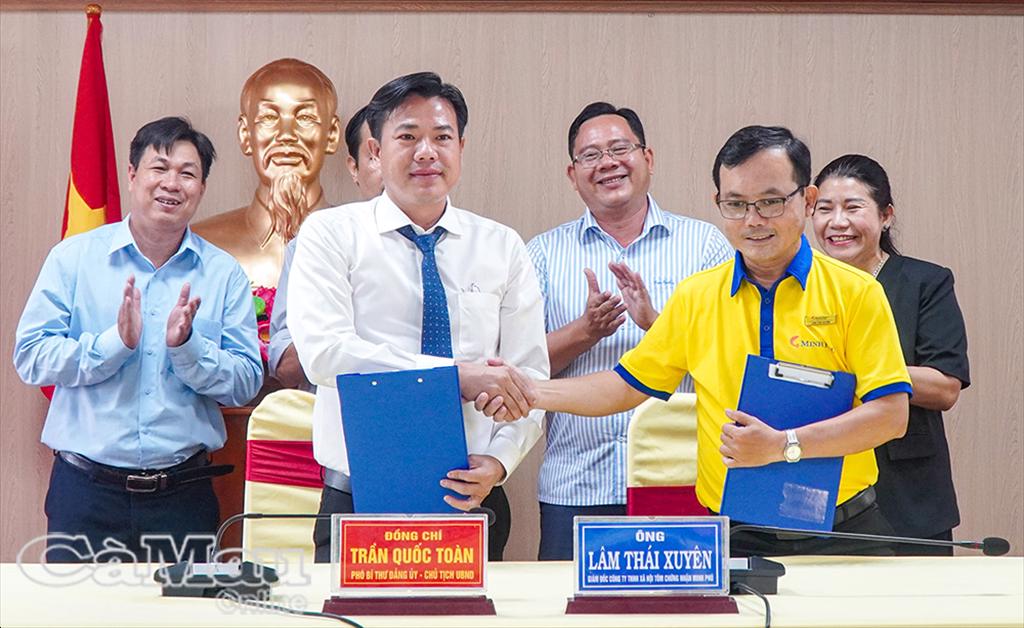
Mr. Tran Quoc Toan, Chairman of the People’s Committee of Ho Thi Ky Commune, and Mr. Lam Thai Xuyen, Director of Minh Phu Certified Shrimp Social Co., Ltd., signed the memorandum of understanding.
The development of the shrimp farming area is oriented toward improving productivity, output, product quality, and value through the application of scientific and technological advances, restructuring farming methods, and reorganizing production, thereby creating a foundation for faster, more sustainable, and more efficient growth.
The planned area of 1,500 hectares will be implemented in three phases: Phase 1 (2026) will cover 500 hectares; Phase 2 (2027–2028) will expand to 1,000 hectares; and Phase 3 (2028–2030) will continue expansion to reach 1,500 hectares. The production model applied will be shrimp-rice rotational farming, with black tiger shrimp as the main cultured species, aiming to maximize ecological advantages, reduce disease risks, and increase economic value across the region.
The shrimp farming development plan focuses on completing zoning plans and investing in synchronized infrastructure suitable for the ecological conditions of each area. Priority will be given to expanding black tiger shrimp farming under improved extensive farming and shrimp-rice models associated with quality standards and international certifications such as ASC. Based on transportation, electricity, and irrigation planning, local authorities will review and invest in infrastructure to support the development of large-scale concentrated farming areas applying science and technology while ensuring environmental sustainability.
Production organization will be restructured along the value chain model by linking farming households into cooperative groups and cooperatives. Enterprises will play a central role in supplying inputs, purchasing outputs, and sharing risks. ASC-certified farming areas will prioritize partnerships with certified shrimp seed suppliers starting from 2026, while gradually assigning identification codes to farming zones and developing eco-labels for Ho Thi Ky shrimp and Ca Mau shrimp products. Internationally certified value-chain linkage models will also be developed and replicated.
Regarding market development, favorable conditions will be created for enterprises and cooperatives to participate in the Ca Mau Shrimp Festival, promote the advantages of ecological shrimp-rice farming, and attract major companies to invest in certified raw material areas. At the same time, mechanisms linking processing plants with farming areas will be improved, while branding, geographical indications, and stricter control of trade fraud will also be strengthened.
The application of science and technology will be accelerated through VietGAP and GlobalGAP production processes, while gradually expanding ASC-certified farming areas. Environmental management and disease prevention efforts will focus on waste control, environmental impact assessment, disease prevention awareness campaigns, and epidemiological monitoring.
Human resource capacity will be strengthened through training for management and technical staff, reinforcing cooperatives and cooperative groups, and providing training on traceability systems. In parallel, communication activities will be enhanced to raise community awareness and strengthen cooperation with international organizations such as MCD, World Fish Foundation, GIZ, and Mekong Organics in order to apply technological advances and promote clean shrimp farming models to both domestic and international markets.
Mr. Lam Thai Xuyen, Director of Minh Phu Certified Shrimp Social Co., Ltd., presented the results of the survey and selection of farming households participating in the internationally certified shrimp project in Ho Thi Ky Commune in 2026. He also shared information on the advantages, challenges, and experiences gained in developing internationally certified shrimp farming areas in recent years.
Mr. Tran Quoc Toan, Chairman of the People’s Committee of Ho Thi Ky Commune, delivered the opening remarks at the signing ceremony for the development of an internationally certified black tiger shrimp farming area for the 2026–2030 period in the commune.
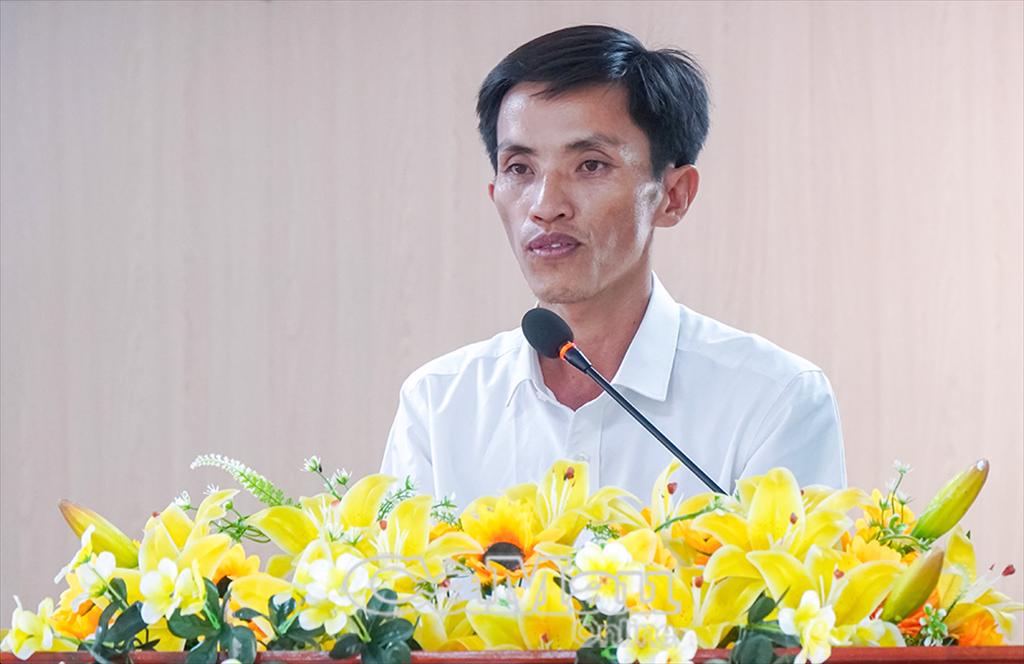
Mr. Vo Minh Tri, Chairman of the Board of Directors of De Tay General Services Cooperative, shared experiences in mobilizing and encouraging local households to voluntarily participate in the internationally certified shrimp project.
(seafood.vasep.com.vn) Vietnamese seafood exports recorded impressive growth, generating nearly 6 billion USD in revenue during the first six months of the year, up 13% compared with the same period last year.
(seafood.vasep.com.vn) Fishermen in Ha Tinh are gradually overcoming difficulties to maintain the efficiency of seafood exploitation. In the first six months of 2026, the entire province achieved a production of more than 23,000 tons of seafood, worth more than 1,200 billion VND.
(seafood.vasep.com.vn) June 2026 brought encouraging signs for Vietnam's tuna exports, with export value rising 20% year-on-year to nearly USD 72 million. However, this increase has yet to offset the prolonged slowdown seen in key markets such as the European Union (EU), where import demand remains weak. The outlook for the second half of the year is expected to become more challenging as freight rates continue to climb.
(vasep.com.vn) As part of the Vietnam Fisheries International Exhibition (Vietfish 2026), the Vietnam Association of Seafood Exporters and Producers (VASEP), in collaboration with the Agency for Domestic Market Management and Development under the Ministry of Industry and Trade, will organize the Domestic Seafood Supply–Demand Matching Program on the morning of August 20, 2026, at the Saigon Exhibition and Convention Center (SECC), Ho Chi Minh City. The program aims to foster direct business connections between Vietnamese seafood producers and processors and domestic distributors, retailers, and foodservice channels.
(seafood.vasep.com.vn) The Cooking Show will be one of the most engaging experiential highlights of Vietfish 2026. Taking place over three days, from August 19–21, 2026, at Hall B1, SECC, Ho Chi Minh City, the event will offer visitors a vibrant culinary space where Vietnamese seafood is showcased through its flavors, stories, and real-life culinary applications.
(seafood.vasep.com.vn) Vietnam's pangasius exports reached USD 205 million in June 2026, up 5% compared with the same month in 2025. Cumulative export value for the first six months of the year totaled USD 1.1 billion, an increase of 12% year-on-year. Growth was primarily driven by strong demand from China and CPTPP markets, while exports to the United States and Brazil continued to decline.
(seafood.vasep.com.vn) In the first six months of 2026, Ha Tinh province continued to implement comprehensive solutions to combat IUU fishing; strictly manage the fishing fleet, control fishing vessels entering and leaving ports, operate vessel tracking devices, trace the origin of seafood, and severely punish violations.
(seafood.vasep.com.vn) Vietnam's tilapia exports reached USD 7 million in June 2026, down 32% compared with the same month in 2025. Nevertheless, thanks to strong growth in the first five months of the year, cumulative tilapia exports in the first half of 2026 totaled USD 69 million, up 67% year on year.
(seafood.vasep.com.vn) Sa Giang Import-Export Joint Stock Company, a member of the Vietnam Association of Seafood Exporters and Producers (VASEP), has been honored with the "Famous Brand - Competitive Vietnamese Brand 2026" certification at an award ceremony organized by the Vietnam Intellectual Property Association (VIPA).
(seafood.vasep.com.vn) China imported nearly $1.4 billion worth of Vietnamese seafood in the first half of the year, a 40% increase compared to the same period last year, surpassing the US to become the largest export market for the industry.
VASEP - HIỆP HỘI CHẾ BIẾN VÀ XUẤT KHẨU THỦY SẢN VIỆT NAM
Chịu trách nhiệm: Ông Nguyễn Hoài Nam - Phó Tổng thư ký Hiệp hội
Đơn vị vận hành trang tin điện tử: Trung tâm VASEP.PRO
Trưởng Ban Biên tập: Bà Phùng Thị Kim Thu
Giấy phép hoạt động Trang thông tin điện tử tổng hợp số 138/GP-TTĐT, ngày 01/10/2013 của Bộ Thông tin và Truyền thông
Tel: (+84 24) 3.7715055 – (ext.203); email: kimthu@vasep.com.vn
Trụ sở: Số 7 đường Nguyễn Quý Cảnh, Phường An Phú, Quận 2, Tp.Hồ Chí Minh
Tel: (+84) 28.628.10430 - Fax: (+84) 28.628.10437 - Email: vasephcm@vasep.com.vn
VPĐD: số 10, Nguyễn Công Hoan, Ngọc Khánh, Ba Đình, Hà Nội
Tel: (+84 24) 3.7715055 - Fax: (+84 24) 37715084 - Email: vasephn@vasep.com.vn