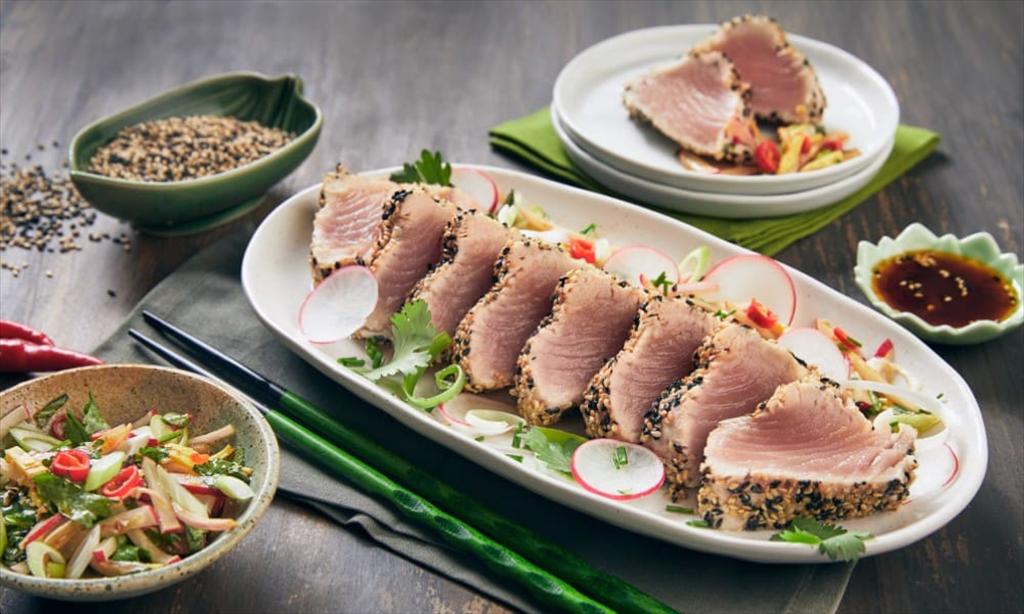
June growth driven by a recovery in exports
According to Vietnam Customs, tuna exports reached nearly USD 72 million in June 2026, up 20% compared with the same month last year. This marked the first strong monthly rebound following several months of sluggish export performance.
Nevertheless, cumulative tuna exports for the first six months of 2026 totaled USD 355 million, down 5% year-on-year. Although the decline narrowed from 7% recorded after the first five months, the industry has yet to return to a growth trajectory.
Export growth was recorded in 18 out of the top 20 markets, with the strongest increases seen in Russia (+83%), the Philippines (+31%), the United Arab Emirates (+29%), Israel (+17%), and the CPTPP market (+6%).
The market picture remains highly fragmented. While some destinations have shown signs of recovery, others continue to struggle with weak demand.
U.S. market recovers slightly but tariffs remain a concern
Tuna exports to the United States reached nearly USD 35 million in June, up 6% year-on-year after a prolonged period of decline. This rebound reflects importers' efforts to rebuild inventories ahead of potential changes in U.S. tariff policies.
However, the growth remains modest. U.S. importers continue to exercise caution due to uncertainty surrounding future tariff measures. Following the U.S. Supreme Court's suspension of IEEPA tariff orders, the White House has announced plans to introduce new tariffs under Section 301, creating additional uncertainty for importers.
CATEX fails to revive the EU market
The European Union remains the biggest challenge. Tuna exports to the EU fell 18% in June.
Despite the implementation of the Vietnam–EU Countervailing Measures and Trade Enhancement (CATEX) initiative, the agreement has yet to generate a significant boost in export performance. Market demand remains weak, while European buyers continue to reduce inventories and purchase only when necessary.
Another concern is the new traceability and sustainability requirements under the EU's Illegal, Unreported and Unregulated (IUU) fishing regulations and broader environmental policies. These stricter standards are forcing Vietnamese exporters to invest more heavily in compliance and supply chain transparency.
Indonesia gains ground as competition intensifies
While Vietnam faces headwinds in traditional markets, Indonesia is gradually strengthening its position in the EU.
Indonesia benefits from abundant tuna resources, preferential tariff treatment under several trade agreements, and a fishing fleet that has increasingly improved its ability to meet sustainability and traceability standards. As a result, Indonesian tuna is becoming more competitive in Europe.
This shift presents additional challenges for Vietnamese exporters, particularly as Indonesia continues to expand its market presence in the EU.
Rising freight costs add further pressure
In addition to weak demand, soaring ocean freight rates are placing increasing pressure on Vietnam's tuna exporters. Most tuna products are shipped over long distances to the U.S. and Europe, making logistics costs a critical factor affecting competitiveness.
Higher freight rates are driving up export costs, squeezing profit margins, and increasing delivery risks. For frozen tuna loins, cooked loins, canned tuna, and other processed products supplied to retail chains, much of the increased transport cost cannot be passed on to buyers.
As a result, the second half of 2026 will require exporters not only to secure new orders but also to optimize logistics, diversify markets, and improve operational efficiency in order to remain competitive in an increasingly challenging global market.
(vasep.com.vn) Markets are changing faster, buyer requirements are becoming more demanding, and trade barriers are growing increasingly complex. In this environment, seafood businesses need more than an understanding of current market conditions. They need a longer-term perspective to answer a critical question: Where will growth opportunities come from in 2027–2029, and what should businesses do now to prepare? This is one of the key reasons why VASEP is organizing Vietnam Seafood Summit 2026.
(vasep.com.vn) In the first eight months of 2026, Vietnam’s pangasius exports to the Middle East reached US$113 million, up 7% year on year from the same period in 2025. Growth has become more pronounced in recent months. In August alone, exports to the region totaled US$20 million, an increase of 24%. This indicates that demand for Vietnamese pangasius in the Middle East is gradually recovering after a slowdown in March, although the pace of recovery varies across markets.
(vasep.com.vn) China’s shrimp imports continued to grow strongly in 2026, while Vietnam’s shrimp exports to the market also recorded notable growth. However, behind these positive figures lie two distinct trends: Chinese consumption is growing more slowly than imports, and lobster accounts for a substantial share of Vietnam’s shrimp exports to China, making its product mix significantly different from those of Ecuador and India. Exporters therefore need to assess each segment carefully to understand the opportunities and risks.
(vasep.com.vn) Changing markets, shifting buyer demand, and increasingly complex trade barriers are raising a key question for Vietnam’s seafood industry: Where will the new growth opportunities lie in 2027–2029?
(seafood.vasep.com.vn) As of the end of August 2026, Vietnam’s tilapia exports to the United States reached $21 million, representing a steep 48% year-over-year decline and accounting for 23% of the country's total tilapia export turnover. Frozen fillets accounted for 78% with the remainder consisting of whole frozen tilapia and frozen cuts.
(seafood.vasep.com.vn) After a volatile first half of the year, Vietnam’s pangasius exports to Brazil registered robust growth in July and August 2026. In August alone, export turnover reached $19 million, surging 73% compared to the same period in 2025. Cumulatively for the first eight months, total export value reached $124 million, reflecting an 8% year-over-year increase.
(seafood.vasep.com.vn) Besides modifying their boats, many fishermen in Dak Lak province are making efforts to venture out to sea to harvest seafood during the rough sea season.
(seafood.vasep.com.vn) At the Responsible Seafood Summit and TCRS Shrimp Summit 2026, organized by the GSA (Global Seafood Alliance) in Bangkok, Thailand, the conversation about the future of the shrimp industry began with one of its most important foundations: seedstock quality.
(seafood.vasep.com.vn) In the first eight months of 2026, Vietnam’s tuna exports to Lithuania surpassed $14 million, up 8% year on year. While the increase remains modest, it is notable given the continued pressure on Vietnamese tuna exports to the EU as a whole. More importantly, export turnover to Lithuania has shown a clearer recovery in recent months, making the market a destination worth monitoring for Vietnamese businesses in Europe.
(seafood.vasep.com.vn) Vietnam’s squid and octopus exports exceeded $527 million in the first eight months of 2026, marking a 15% year-on-year increase. This growth is particularly notable given the strong baseline established in 2025, when export turnover for the same period reached $458 million, a 13% rise from 2024.
VASEP - HIỆP HỘI CHẾ BIẾN VÀ XUẤT KHẨU THỦY SẢN VIỆT NAM
Chịu trách nhiệm: Ông Nguyễn Hoài Nam - Phó Tổng thư ký Hiệp hội
Đơn vị vận hành trang tin điện tử: Trung tâm VASEP.PRO
Trưởng Ban Biên tập: Bà Phùng Thị Kim Thu
Giấy phép hoạt động Trang thông tin điện tử tổng hợp số 138/GP-TTĐT, ngày 01/10/2013 của Bộ Thông tin và Truyền thông
Tel: (+84 24) 3.7715055 – (ext.203); email: kimthu@vasep.com.vn
Trụ sở: Số 7 đường Nguyễn Quý Cảnh, Phường An Phú, Quận 2, Tp.Hồ Chí Minh
Tel: (+84) 28.628.10430 - Fax: (+84) 28.628.10437 - Email: vasephcm@vasep.com.vn
VPĐD: số 10, Nguyễn Công Hoan, Ngọc Khánh, Ba Đình, Hà Nội
Tel: (+84 24) 3.7715055 - Fax: (+84 24) 37715084 - Email: vasephn@vasep.com.vn