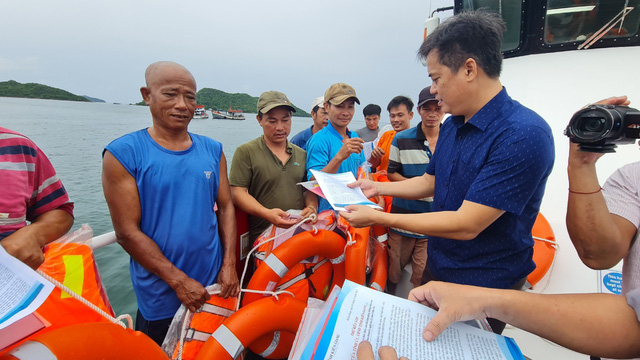
Recently, Ca Mau has drastically implemented key solutions, mobilizing the entire political system - particularly at the grassroots level - to strengthen territorial management, enhance communication and promptly prevent fishing vessels from infringing upon foreign waters.
According to Mr. Pham Van Muoi, Deputy Director of the Department of Agriculture and Environment, the Department proactively advised the Provincial People’s Committee to issue multiple steering documents and specific action plans. It also organized inspections and supervision of implementation in coastal localities. All 19 tasks assigned by the Prime Minister and the National Steering Committee on IUU were fully implemented on schedule with no delays.
The province’s anti-IUU efforts have seen a clear, comprehensive, and practical transformation. Completing all central-level mandates, strictly managing the fleet, effectively controlling fishing activities, and severely penalizing violations have created a firm premise to move toward removing the EC's "yellow card."
One of the most prominent achievements of Ca Mau’s anti-IUU campaign in 2025 is the legal regularization of its fishing fleet.
As of December 19, 2025, all 5,181 fishing vessels in the province are 100% registered and fully updated on the VNFishbase system and 100% have been granted fishing licenses. There are no vessels lacking proper registration or licensing.
For vessels that are inactive or no longer in use, the province has tasked local authorities with strict monitoring, including photographing mooring locations every seven days to digitize records and ensure that unqualified vessels do not return to fishing activities.
Furthermore, 100% of fishing vessels have been marked with identification numbers and the registration of vessels used for aquaculture services has been completed, eliminating the status of "off-the-grid" vessels with unidentified information.
Vessel monitoring and port control continue to be strictly and continuously enforced. Currently, 100% of active vessels 15 meters or longer have installed Vessel Monitoring Systems (VMS) and maintain 24/7 connectivity, even when docked. The monitoring stations are maintained around the clock to promptly detect, warn, and demand vessels return to Vietnamese waters if they cross boundaries.
Importantly, the province has deployed the electronic Catch Documentation and Traceability (eCDT) system at all fishing ports, ensuring that 100% of vessels 15 meters or longer perform port entry/departure procedures and maintain electronic logs. To date, 4,493 vessels have fully complied with the eCDT process.
The processing of catch certificates and origin confirmations has been conducted in strict accordance with regulations with no documentation errors requiring clarification. In 2025, the province issued: 28 receipts for 171 tons of seafood (cumulative: 1,360 receipts/7,627 tons); 5 Statement of Catch (SC) certificates for 58,170 tons (cumulative: 903 certificates/12,875.04 tons) and 7 Catch Certificates (CC) for 83,817 tons (cumulative: 877 certificates/12,460.578 tons).
In addition to technical and legal measures, Ca Mau has placed special emphasis on propaganda and advocacy. In 2025, the province conducted 102 documentaries and 877 news articles in print and online media; distributed 18,870 leaflets, 5,000 brochures and 10,000 posters; organized 47 training sessions with 4,007 participants and sent 51,403 informational messages to fishers.
The commune-level broadcasting system airs anti-IUU content twice daily, helping to elevate awareness and fostering consensus among fishing communities.
(seafood.vasep.com.vn) Vietnamese seafood exports recorded impressive growth, generating nearly 6 billion USD in revenue during the first six months of the year, up 13% compared with the same period last year.
(seafood.vasep.com.vn) Fishermen in Ha Tinh are gradually overcoming difficulties to maintain the efficiency of seafood exploitation. In the first six months of 2026, the entire province achieved a production of more than 23,000 tons of seafood, worth more than 1,200 billion VND.
(seafood.vasep.com.vn) June 2026 brought encouraging signs for Vietnam's tuna exports, with export value rising 20% year-on-year to nearly USD 72 million. However, this increase has yet to offset the prolonged slowdown seen in key markets such as the European Union (EU), where import demand remains weak. The outlook for the second half of the year is expected to become more challenging as freight rates continue to climb.
(vasep.com.vn) As part of the Vietnam Fisheries International Exhibition (Vietfish 2026), the Vietnam Association of Seafood Exporters and Producers (VASEP), in collaboration with the Agency for Domestic Market Management and Development under the Ministry of Industry and Trade, will organize the Domestic Seafood Supply–Demand Matching Program on the morning of August 20, 2026, at the Saigon Exhibition and Convention Center (SECC), Ho Chi Minh City. The program aims to foster direct business connections between Vietnamese seafood producers and processors and domestic distributors, retailers, and foodservice channels.
(seafood.vasep.com.vn) The Cooking Show will be one of the most engaging experiential highlights of Vietfish 2026. Taking place over three days, from August 19–21, 2026, at Hall B1, SECC, Ho Chi Minh City, the event will offer visitors a vibrant culinary space where Vietnamese seafood is showcased through its flavors, stories, and real-life culinary applications.
(seafood.vasep.com.vn) Vietnam's pangasius exports reached USD 205 million in June 2026, up 5% compared with the same month in 2025. Cumulative export value for the first six months of the year totaled USD 1.1 billion, an increase of 12% year-on-year. Growth was primarily driven by strong demand from China and CPTPP markets, while exports to the United States and Brazil continued to decline.
(seafood.vasep.com.vn) In the first six months of 2026, Ha Tinh province continued to implement comprehensive solutions to combat IUU fishing; strictly manage the fishing fleet, control fishing vessels entering and leaving ports, operate vessel tracking devices, trace the origin of seafood, and severely punish violations.
(seafood.vasep.com.vn) Vietnam's tilapia exports reached USD 7 million in June 2026, down 32% compared with the same month in 2025. Nevertheless, thanks to strong growth in the first five months of the year, cumulative tilapia exports in the first half of 2026 totaled USD 69 million, up 67% year on year.
(seafood.vasep.com.vn) Sa Giang Import-Export Joint Stock Company, a member of the Vietnam Association of Seafood Exporters and Producers (VASEP), has been honored with the "Famous Brand - Competitive Vietnamese Brand 2026" certification at an award ceremony organized by the Vietnam Intellectual Property Association (VIPA).
(seafood.vasep.com.vn) China imported nearly $1.4 billion worth of Vietnamese seafood in the first half of the year, a 40% increase compared to the same period last year, surpassing the US to become the largest export market for the industry.
VASEP - HIỆP HỘI CHẾ BIẾN VÀ XUẤT KHẨU THỦY SẢN VIỆT NAM
Chịu trách nhiệm: Ông Nguyễn Hoài Nam - Phó Tổng thư ký Hiệp hội
Đơn vị vận hành trang tin điện tử: Trung tâm VASEP.PRO
Trưởng Ban Biên tập: Bà Phùng Thị Kim Thu
Giấy phép hoạt động Trang thông tin điện tử tổng hợp số 138/GP-TTĐT, ngày 01/10/2013 của Bộ Thông tin và Truyền thông
Tel: (+84 24) 3.7715055 – (ext.203); email: kimthu@vasep.com.vn
Trụ sở: Số 7 đường Nguyễn Quý Cảnh, Phường An Phú, Quận 2, Tp.Hồ Chí Minh
Tel: (+84) 28.628.10430 - Fax: (+84) 28.628.10437 - Email: vasephcm@vasep.com.vn
VPĐD: số 10, Nguyễn Công Hoan, Ngọc Khánh, Ba Đình, Hà Nội
Tel: (+84 24) 3.7715055 - Fax: (+84 24) 37715084 - Email: vasephn@vasep.com.vn