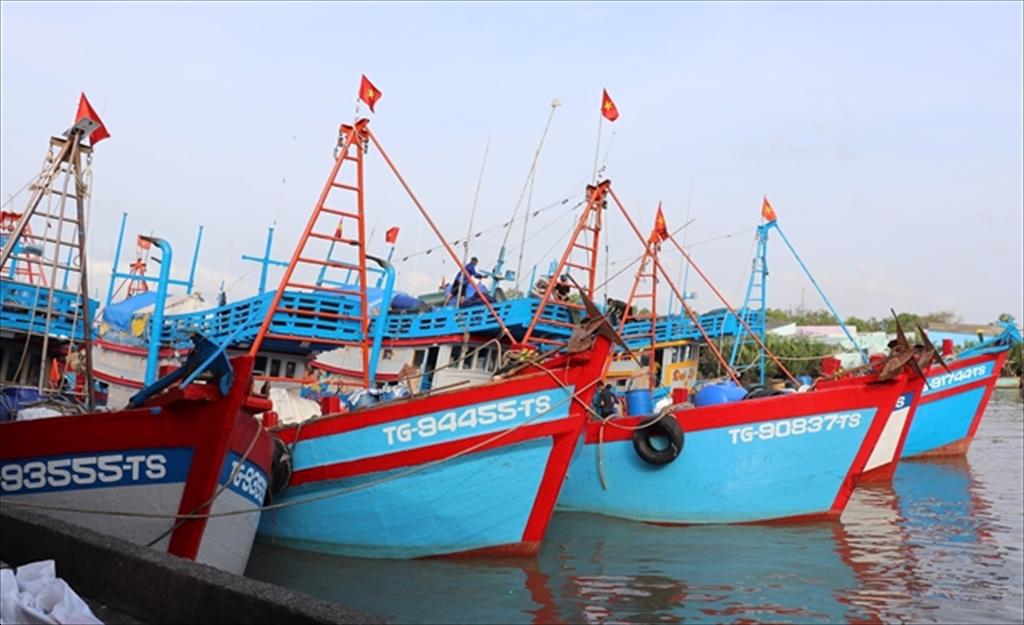
Đồng Tháp Province has intensified efforts to curb illegal fishing by strengthening vessel monitoring, law enforcement and seafood traceability.
The move aims to help secure the removal of the European Commission (EC) “yellow card” warning against Việt Nam’s seafood exports over illegal, unreported and unregulated (IUU) fishing.
The Cửu Long (Mekong) Delta province will continue implementing comprehensive measures in line with the Government’s directions and the EC’s recommendations, according to its Steering Committee for Combating IUU Fishing.
The focus will be on tightening the management of the fishing fleet to ensure that all vessels eligible to operate are registered, inspected, licensed for fishing, and equipped with vessel monitoring system (VMS) devices that remain connected in accordance with regulations.
The province will also tighten control over vessels entering and leaving ports, monitor seafood landings at ports and strengthen the verification and certification of seafood origin.
It will intensify patrols and inspections while strictly handling violations, particularly cases involving disconnected VMS devices, vessels crossing permitted maritime boundaries and illegal fishing activities.
It is also increasing public awareness campaigns to improve fishermen's understanding of and compliance with the law. High-risk fishing vessels are being closely monitored.
According to the steering committee, all active fishing vessels have been registered, inspected, licensed, marked for identification and managed in accordance with regulations.
The province has also placed fishing vessels that are not eligible to operate under strict management.
Every week, the Provincial Department of Agriculture and Environment updates the list of ineligible vessels, high-risk vessels and those with long-term VMS service interruptions so local authorities can monitor them.
Their mooring locations have been identified, records are maintained, regular inspections are carried out, and they are not allowed to fish.
To monitor fishing activities, relevant agencies maintain a 24/7 duty system to track signals from VMS devices. This enables them to promptly warn vessels that lose connection or show signs of crossing maritime boundaries.
The Department of Agriculture and Environment, the Border Guard and local authorities also work closely together to monitor vessels entering and leaving ports.
The province has two fishing ports – Mỹ Tho Fishing Port and Vàm Láng Fishing Port.
The fishing ports have received 3,408 vessel arrivals, with more than 20,243 tonnes of seafood landed, since the beginning of the year.
All landed seafood has been fully recorded in the electronic system to support traceability.
The province has continued to strictly implement procedures for verifying, certifying and tracing seafood origin.
It has not detected any seafood shipments exported to the European market that have violated IUU fishing regulations or required origin verification so far this year.
Law enforcement has also been strengthened. Authorities fined those responsible for 53 IUU-related violations, with total penalties of nearly VNĐ4 billion (US$152,000) in the first six months of the year.
During the period, no fishing vessels from the province have been found operating illegally in foreign waters.
(seafood.vasep.com.vn) The application of high technology in shrimp farming is delivering positive results in the coastal areas of Vinh Long Province, contributing to improved production efficiency and creating significant potential for further industry expansion. However, to fully capitalize on this potential, the province is focusing on aquaculture zoning, infrastructure investment, and promoting modern, sustainable production.
(seafood.vasep.com.vn) Đồng Tháp Province has intensified efforts to curb illegal fishing by strengthening vessel monitoring, law enforcement and seafood traceability.
(seafood.vasep.com.vn) Seafood businesses need solutions to overcome bottlenecks such as labor shortages, difficulty accessing capital, high input costs, and administrative procedures in order to maintain production, adapt to market fluctuations, and effectively exploit export opportunities.
(seafood.vasep.com.vn) The FTA would widen access to markets with strong demand for premium food products in line with the country’s strategy of shifting exports towards increasing added value.
(seafood.vasep.com.vn) On the morning of July 13th, Mr. Ho Quoc Dung, Member of the Central Committee of the Communist Party of Vietnam and Deputy Prime Minister, along with his delegation, visited and worked with businesses in An Giang province to promptly resolve obstacles and promote production and business activities.
(seafood.vasep.com.vn) As importing markets increasingly focus on biosecurity and traceability, Vietnam has established a relatively comprehensive legal framework and disease management system for aquaculture, covering tilapia farming as well as other cultured species. This system is based on the Law on Animal Health, regulations on the prevention and control of aquatic animal diseases, the National Plan for the Prevention and Control of Major Diseases in Farmed Aquatic Species, and environmental monitoring and early warning programs for aquaculture areas.
(seafood.vasep.com.vn) On July 9, 2026, the Embassy of Vietnam in Brazil organized the seminar titled “Sharing Information on Vietnam-Brazil Economic, Trade and Investment Relations in the First Half of 2026” to provide updates on bilateral cooperation and strengthen connections among government agencies, industry associations, and business communities of the two countries.
(seafood.vasep.com.vn) Seafood exports in the first 6 months of the year continued to be a bright spot with a total turnover of 5.7 billion USD, an increase of 11.4% compared to the same period last year. By commodity group, seafood is one of the three groups with a trade balance in the first 6 months of 2026 in a surplus state with 4.13 billion USD, an increase of 17%.
(seafood.vasep.com.vn) For many years, Vietnam’s seafood industry has been recognized as one of the country’s key export pillars. Products such as shrimp, pangasius, tuna, squid, octopus, and a wide range of other seafood have reached hundreds of markets worldwide. Yet behind these impressive export figures lies a significant challenge: a substantial share of Vietnam’s seafood export value still comes from minimally processed products, contract manufacturing, and raw material exports—segments characterized by low profit margins and high vulnerability to fluctuations in global prices.
(seafood.vasep.com.vn) In the context of a global economy shifting powerfully toward green and sustainable values, Vietfish 2026 is far more than just a commercial trade fair. It has become a strategic rendezvous and a "comprehensive ecosystem"—a convergence of value, knowledge, and sustainable growth opportunities for the entire industry chain.
VASEP - HIỆP HỘI CHẾ BIẾN VÀ XUẤT KHẨU THỦY SẢN VIỆT NAM
Chịu trách nhiệm: Ông Nguyễn Hoài Nam - Phó Tổng thư ký Hiệp hội
Đơn vị vận hành trang tin điện tử: Trung tâm VASEP.PRO
Trưởng Ban Biên tập: Bà Phùng Thị Kim Thu
Giấy phép hoạt động Trang thông tin điện tử tổng hợp số 138/GP-TTĐT, ngày 01/10/2013 của Bộ Thông tin và Truyền thông
Tel: (+84 24) 3.7715055 – (ext.203); email: kimthu@vasep.com.vn
Trụ sở: Số 7 đường Nguyễn Quý Cảnh, Phường An Phú, Quận 2, Tp.Hồ Chí Minh
Tel: (+84) 28.628.10430 - Fax: (+84) 28.628.10437 - Email: vasephcm@vasep.com.vn
VPĐD: số 10, Nguyễn Công Hoan, Ngọc Khánh, Ba Đình, Hà Nội
Tel: (+84 24) 3.7715055 - Fax: (+84 24) 37715084 - Email: vasephn@vasep.com.vn