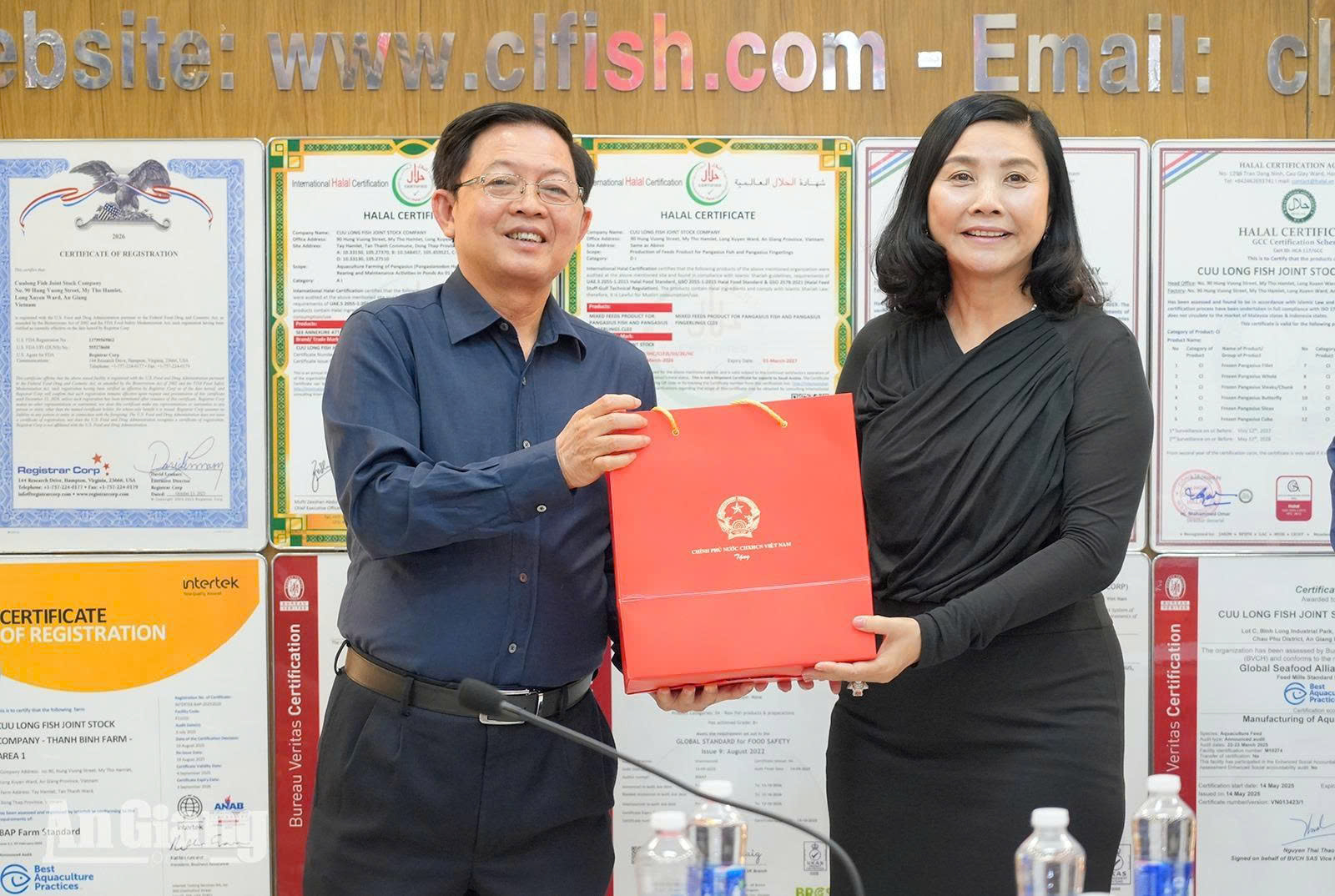
During the program, Deputy Prime Minister Ho Quoc Dung and the delegation visited and inspected two key units: An Giang Fruit and Vegetable Foodstuff Joint Stock Company (Antesco) in Binh Long Industrial Park (Chau Phu commune) and Cuu Long An Giang Seafood Import-Export Joint Stock Company in My Quy Industrial Cluster (Long Xuyen city).
Joining the local delegation were Mr. Nguyen Tien Hai, Member of the Central Committee of the Communist Party of Vietnam and Secretary of the An Giang Provincial Party Committee, along with leaders of the Provincial People's Committee and various provincial departments and agencies.
Antesco currently has 4 factories located in An Giang and Lam Dong provinces, with a total capacity of 50,000 tons of finished products per year, a linked raw material area of 15,000 hectares, maintaining 1,800 regular workers and creating livelihoods for more than 4,500 farming households through product purchase contracts.
According to a report by Cuu Long An Giang Seafood Import-Export Joint Stock Company, in the first six months of 2026, the company harvested approximately 12,000 tons of raw pangasius fish, produced 9,000 tons of frozen pangasius fillet, and exported 10,064 tons of products to 70 countries and territories. Export turnover reached over 21 million USD, with revenue of 942 billion VND.
The company currently manages 6 farming areas with a total area of over 100 hectares, meeting almost 100% of the raw material needs for the processing plant, providing employment for more than 2,000 workers with an average income of 8 million VND/person/month.”
During the working sessions, An Giang Provincial Party Secretary Nguyen Tien Hai emphasized the strategic role of closely linking businesses and farmers. He also urged businesses to build sustainable supply chains and strengthen cooperation with farmers through cooperative models to form large, tightly-knit raw material areas.
Promote the transfer of modern technology, support people in changing traditional farming methods, and apply advanced techniques to improve productivity; invest in post-harvest technology, support rapid harvesting and modern preservation technologies to ensure the quality of raw materials for factories, and optimize production value; businesses need to pay attention to the lives of their employees, especially focusing on and supporting the construction of housing for workers.
The Secretary of the An Giang Provincial Party Committee also directed the provincial agricultural sector to send experts to closely monitor the area and support the development of synchronized raw material zones in a sustainable manner.
Speaking at the meeting, Deputy Prime Minister Ho Quoc Dung highly appreciated the efforts of businesses in maintaining production and contributing to the socio-economic development of the locality.
The Deputy Prime Minister requested that the leaders of An Giang province and relevant departments and agencies proactively and quickly review and definitively resolve the legitimate requests of businesses, creating the most favorable conditions for businesses to confidently recover and achieve breakthroughs in production.
The Deputy Prime Minister also noted that businesses need to pay close attention to production linkages in business, as well as raw material area planning; continue to strive to invest in high technology in production, digitize planting area codes, traceability, and at the same time ensure environmental protection...
Deputy Prime Minister Ho Quoc Dung stated that, within the government's authority, it will consider and provide assistance and support to businesses, especially the pangasius industry, to develop.
(seafood.vasep.com.vn) Vietnam’s pangasius exports have shown encouraging signs of recovery in 2026. In the first four months of the year, total export turnover reached USD 720 million, up 17% compared to the same period last year. This result reflects improving demand across many markets, as well as the efforts of Vietnamese pangasius enterprises to maintain production, secure orders, and adapt to changing market conditions.
(seafood.vasep.com.vn) The application of high technology in shrimp farming is delivering positive results in the coastal areas of Vinh Long Province, contributing to improved production efficiency and creating significant potential for further industry expansion. However, to fully capitalize on this potential, the province is focusing on aquaculture zoning, infrastructure investment, and promoting modern, sustainable production.
(seafood.vasep.com.vn) Đồng Tháp Province has intensified efforts to curb illegal fishing by strengthening vessel monitoring, law enforcement and seafood traceability.
(seafood.vasep.com.vn) Seafood businesses need solutions to overcome bottlenecks such as labor shortages, difficulty accessing capital, high input costs, and administrative procedures in order to maintain production, adapt to market fluctuations, and effectively exploit export opportunities.
(seafood.vasep.com.vn) The FTA would widen access to markets with strong demand for premium food products in line with the country’s strategy of shifting exports towards increasing added value.
(seafood.vasep.com.vn) On the morning of July 13th, Mr. Ho Quoc Dung, Member of the Central Committee of the Communist Party of Vietnam and Deputy Prime Minister, along with his delegation, visited and worked with businesses in An Giang province to promptly resolve obstacles and promote production and business activities.
(seafood.vasep.com.vn) As importing markets increasingly focus on biosecurity and traceability, Vietnam has established a relatively comprehensive legal framework and disease management system for aquaculture, covering tilapia farming as well as other cultured species. This system is based on the Law on Animal Health, regulations on the prevention and control of aquatic animal diseases, the National Plan for the Prevention and Control of Major Diseases in Farmed Aquatic Species, and environmental monitoring and early warning programs for aquaculture areas.
(seafood.vasep.com.vn) On July 9, 2026, the Embassy of Vietnam in Brazil organized the seminar titled “Sharing Information on Vietnam-Brazil Economic, Trade and Investment Relations in the First Half of 2026” to provide updates on bilateral cooperation and strengthen connections among government agencies, industry associations, and business communities of the two countries.
(seafood.vasep.com.vn) Seafood exports in the first 6 months of the year continued to be a bright spot with a total turnover of 5.7 billion USD, an increase of 11.4% compared to the same period last year. By commodity group, seafood is one of the three groups with a trade balance in the first 6 months of 2026 in a surplus state with 4.13 billion USD, an increase of 17%.
(seafood.vasep.com.vn) For many years, Vietnam’s seafood industry has been recognized as one of the country’s key export pillars. Products such as shrimp, pangasius, tuna, squid, octopus, and a wide range of other seafood have reached hundreds of markets worldwide. Yet behind these impressive export figures lies a significant challenge: a substantial share of Vietnam’s seafood export value still comes from minimally processed products, contract manufacturing, and raw material exports—segments characterized by low profit margins and high vulnerability to fluctuations in global prices.
VASEP - HIỆP HỘI CHẾ BIẾN VÀ XUẤT KHẨU THỦY SẢN VIỆT NAM
Chịu trách nhiệm: Ông Nguyễn Hoài Nam - Phó Tổng thư ký Hiệp hội
Đơn vị vận hành trang tin điện tử: Trung tâm VASEP.PRO
Trưởng Ban Biên tập: Bà Phùng Thị Kim Thu
Giấy phép hoạt động Trang thông tin điện tử tổng hợp số 138/GP-TTĐT, ngày 01/10/2013 của Bộ Thông tin và Truyền thông
Tel: (+84 24) 3.7715055 – (ext.203); email: kimthu@vasep.com.vn
Trụ sở: Số 7 đường Nguyễn Quý Cảnh, Phường An Phú, Quận 2, Tp.Hồ Chí Minh
Tel: (+84) 28.628.10430 - Fax: (+84) 28.628.10437 - Email: vasephcm@vasep.com.vn
VPĐD: số 10, Nguyễn Công Hoan, Ngọc Khánh, Ba Đình, Hà Nội
Tel: (+84 24) 3.7715055 - Fax: (+84 24) 37715084 - Email: vasephn@vasep.com.vn