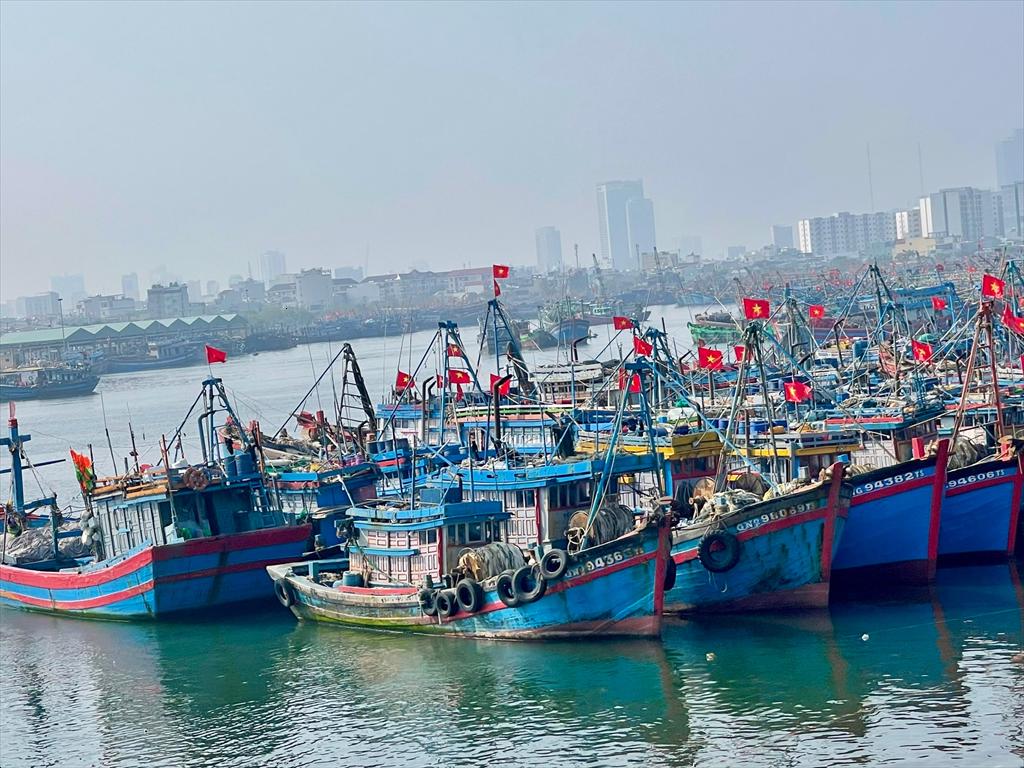
Under the plan to implement corrective measures in response to the recommendations of the European Commission at its fifth inspection on IUU fishing, Ninh Binh has set specific targets to address outstanding issues and limit violations at sea, particularly those related to IUU fishing.
Accordingly, verification must be substantive, while all records, data and supporting documents must be fully prepared to work with the EC and contribute to the nationwide effort to have the EC’s “yellow card” on Vietnam’s seafood industry removed in 2026. At the same time, the province aims to strengthen fisheries management, prevent violations and develop sustainable fisheries.
One of the targets is to ensure that 100% of registered fishing vessels have complete and accurate information updated promptly on the national fisheries database (VNFishbase), including vessel owners, locations, vessel status and operating areas. The province will also ensure that 100% of fishing vessels are equipped with vessel monitoring systems (VMS), and that their equipment is inspected when vessels leave and enter ports.
Any cases involving loss of connection, crossing permitted boundaries or attempts to interfere with VMS equipment must be detected and promptly warned, and the vessels must be thoroughly inspected and handled in accordance with regulations.
The province will also ensure that 100% of trips made by fishing vessels with a length of 6 meters or more are recorded when entering and leaving ports and have information entered into the electronic catch documentation system (eCDT). Fishing vessels with no valid data on the system will not be allowed to leave port until their information is fully updated. Vessels that commit IUU fishing violations will be thoroughly investigated and handled in accordance with their competence and within the prescribed time limits. Results must be promptly updated in the national fisheries database.
At the same time, Ninh Binh will strictly prevent, monitor and take decisive action against fishing vessels from the province that violate regulations while operating in foreign waters. All violations will be investigated, handled and the responsibilities of relevant organizations and individuals determined in accordance with regulations.
In law enforcement, Ninh Binh requires strict application of sanctions and additional remedial measures, ensuring consistent and proper handling without omission. Cases involving violations must be handled in accordance with regulations, with cases subject to administrative penalties resolved within no more than 60 days from the date the case is established. For prolonged cases, the causes and responsibilities must be clearly identified.
For vessels showing signs of criminal activity, such as organizing illegal fishing, taking vessels into foreign waters, falsifying records or falsifying the origin of catches, or interfering with VMS equipment, authorities are required to investigate and handle the cases in accordance with the law.
Determined to complete the EC’s recommendations fully and substantively, Ninh Binh has launched a peak campaign to combat IUU fishing across the province through September 15, 2026.
During this campaign, the Provincial People’s Committee has instructed relevant departments and commune-level People’s Committees with fishing vessels to focus on outstanding tasks, particularly vessel registration, inspection and licensing; installation and maintenance of VMS; monitoring vessel departure and arrival; updating VNFishbase and eCDT data; tracing the origin of catches; and handling cases in which fishing vessels commit IUU fishing violations in foreign waters. Authorities are also required to organize inspections and assign clear responsibilities to agencies, units and individuals for each task and each vessel at high risk of violating regulations.
For commune-level authorities with fishing vessels, the Provincial People’s Committee has requested stronger dissemination of regulations on combating IUU fishing and warnings about the consequences of violating regulations in fishing activities.
Local authorities must review and compile information on fishing vessels, establish and manage lists of vessels that are not eligible for fishing activities, ensure that information on vessel owners is accurate, and regularly update lists of vessels that have committed IUU violations or are at high risk of such violations for monitoring and early warning.
In addition, authorities must review all fishing ports in the area to ensure proper handling and suspension of operations at ports that fail to comply with regulations or cause difficulties or obstacles to fishing vessel management and fisheries production statistics.
The plan particularly emphasizes that the Chairpersons of commune-level People’s Committees with fishing vessels must take responsibility if vessels from their localities violate regulations while operating in foreign waters.
The Provincial People’s Committee has assigned the Department of Agriculture and Environment to monitor and consolidate implementation results and report to the Provincial People’s Committee. The Department of Agriculture and Environment is also responsible for coordinating and summarizing the implementation of IUU fishing prevention and control tasks assigned to relevant departments and localities.
(vasep.com.vn) Markets are changing faster, buyer requirements are becoming more demanding, and trade barriers are growing increasingly complex. In this environment, seafood businesses need more than an understanding of current market conditions. They need a longer-term perspective to answer a critical question: Where will growth opportunities come from in 2027–2029, and what should businesses do now to prepare? This is one of the key reasons why VASEP is organizing Vietnam Seafood Summit 2026.
(vasep.com.vn) In the first eight months of 2026, Vietnam’s pangasius exports to the Middle East reached US$113 million, up 7% year on year from the same period in 2025. Growth has become more pronounced in recent months. In August alone, exports to the region totaled US$20 million, an increase of 24%. This indicates that demand for Vietnamese pangasius in the Middle East is gradually recovering after a slowdown in March, although the pace of recovery varies across markets.
(vasep.com.vn) China’s shrimp imports continued to grow strongly in 2026, while Vietnam’s shrimp exports to the market also recorded notable growth. However, behind these positive figures lie two distinct trends: Chinese consumption is growing more slowly than imports, and lobster accounts for a substantial share of Vietnam’s shrimp exports to China, making its product mix significantly different from those of Ecuador and India. Exporters therefore need to assess each segment carefully to understand the opportunities and risks.
(vasep.com.vn) Changing markets, shifting buyer demand, and increasingly complex trade barriers are raising a key question for Vietnam’s seafood industry: Where will the new growth opportunities lie in 2027–2029?
(seafood.vasep.com.vn) As of the end of August 2026, Vietnam’s tilapia exports to the United States reached $21 million, representing a steep 48% year-over-year decline and accounting for 23% of the country's total tilapia export turnover. Frozen fillets accounted for 78% with the remainder consisting of whole frozen tilapia and frozen cuts.
(seafood.vasep.com.vn) After a volatile first half of the year, Vietnam’s pangasius exports to Brazil registered robust growth in July and August 2026. In August alone, export turnover reached $19 million, surging 73% compared to the same period in 2025. Cumulatively for the first eight months, total export value reached $124 million, reflecting an 8% year-over-year increase.
(seafood.vasep.com.vn) Besides modifying their boats, many fishermen in Dak Lak province are making efforts to venture out to sea to harvest seafood during the rough sea season.
(seafood.vasep.com.vn) At the Responsible Seafood Summit and TCRS Shrimp Summit 2026, organized by the GSA (Global Seafood Alliance) in Bangkok, Thailand, the conversation about the future of the shrimp industry began with one of its most important foundations: seedstock quality.
(seafood.vasep.com.vn) In the first eight months of 2026, Vietnam’s tuna exports to Lithuania surpassed $14 million, up 8% year on year. While the increase remains modest, it is notable given the continued pressure on Vietnamese tuna exports to the EU as a whole. More importantly, export turnover to Lithuania has shown a clearer recovery in recent months, making the market a destination worth monitoring for Vietnamese businesses in Europe.
(seafood.vasep.com.vn) Vietnam’s squid and octopus exports exceeded $527 million in the first eight months of 2026, marking a 15% year-on-year increase. This growth is particularly notable given the strong baseline established in 2025, when export turnover for the same period reached $458 million, a 13% rise from 2024.
VASEP - HIỆP HỘI CHẾ BIẾN VÀ XUẤT KHẨU THỦY SẢN VIỆT NAM
Chịu trách nhiệm: Ông Nguyễn Hoài Nam - Phó Tổng thư ký Hiệp hội
Đơn vị vận hành trang tin điện tử: Trung tâm VASEP.PRO
Trưởng Ban Biên tập: Bà Phùng Thị Kim Thu
Giấy phép hoạt động Trang thông tin điện tử tổng hợp số 138/GP-TTĐT, ngày 01/10/2013 của Bộ Thông tin và Truyền thông
Tel: (+84 24) 3.7715055 – (ext.203); email: kimthu@vasep.com.vn
Trụ sở: Số 7 đường Nguyễn Quý Cảnh, Phường An Phú, Quận 2, Tp.Hồ Chí Minh
Tel: (+84) 28.628.10430 - Fax: (+84) 28.628.10437 - Email: vasephcm@vasep.com.vn
VPĐD: số 10, Nguyễn Công Hoan, Ngọc Khánh, Ba Đình, Hà Nội
Tel: (+84 24) 3.7715055 - Fax: (+84 24) 37715084 - Email: vasephn@vasep.com.vn