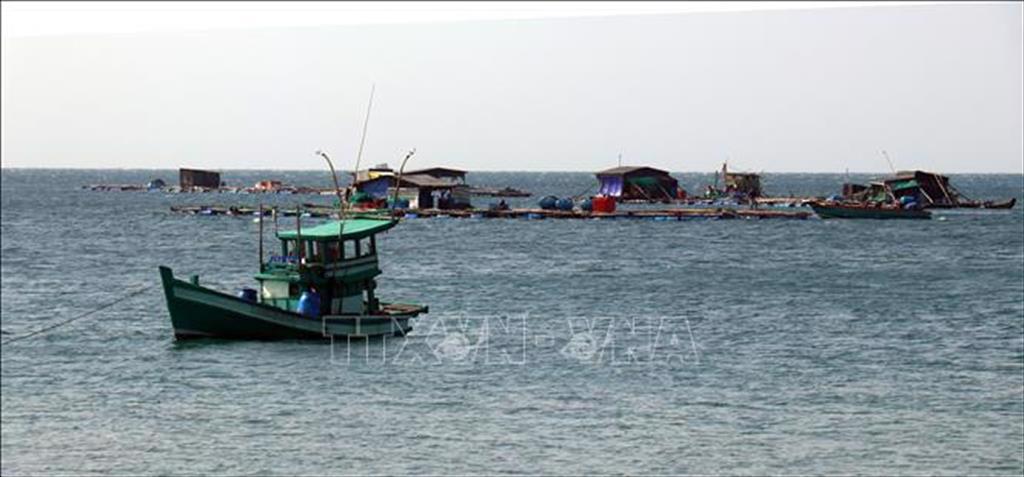
The Mekong Delta province of Kien Giang has planned to further promote sustainable marine aquaculture in line with the “Strategy for the Sustainable Development of Vietnam’s Marine Economy by 2030 with a Vision to 2045”.
Local leaders said the province will fully tap its potential and advantages to promote marine aquaculture in a modern manner in connection with tourism development, while ensuring the environment and national defence and security at seas and islands. The plan aims to contribute to accelerating the restructuring of agriculture, promoting marine economic growth, and improving competitiveness and local incomes. It aims to have 7,500 farming cages by 2025, including 4,700 traditional fish cages, 1,900 hi-tech fish cages, and 900 cages for breeding other seafood. The water surface areas for cage farming and mollusc farming are expected to reach 7,000 ha and 24,000 ha, respectively. The farming yield is to reach 113,530 tonnes and be worth 7.54 trillion VND (327.6 million USD), including 29,870 tonnes from cage farming and 83,660 tonnes from mollusc cultivation. The sector is forecast to employ 18,510 workers. According to the provincial Department of Agriculture and Rural Development, farming areas in Phu Quoc city, Kien Hai island district, the island commune of Tien Hai in Ha Tien city, and Son Hai and Hon Nghe in Kien Luong district will focus on farming groupers, cobias, yellow-fin pompanos, and seabass, as well as blue lobster, mantis shrimp, crab, and oysters for pearl farming. Meanwhile, coastal areas in Ha Tien city and the districts of Kien Luong, Hon Dat, An Minh, and An Bien will develop zones for farming molluscs such as blood cockles, saltwater mussels, green mussels, and oysters. Local authorities must also fully tap the potential and effectively use the sea for farming, towards promoting agricultural economic restructuring, increasing productivity and output, and ensuring food hygiene and safety. The locality has worked hard to create more jobs and improve incomes in coastal communities and those on islands, cut inshore fishing activities, preserve the environment, and minimise activities that deplete natural aquatic resources. It aims to develop marine farming at an industrial-scale using modern technologies that can produce a large volume of products for both export and domestic demand. The province also attaches special importance to promoting links and cooperation in producing raw materials, processing and consuming aquatic products, ensuring food hygiene and safety, and protecting the environment, contributing to protecting and regenerating aquatic resources and preserving biodiversity. It has synchronously implemented solutions on land and water surface areas for marine farming, and mechanisms and policies to boost production and attract investors to high-tech aquaculture. The locality has also paid heed to applying credit and incentive policies to support aquaculture development and high-tech agriculture, as well as to improving the quality of human resources in the sector./.
(vasep.com.vn) Vietnamese pangasius producer Vinh Hoan has won the top prize at the 2026 Seafood Excellence Asia Awards for its Cured Panga Croquette, highlighting the growing potential of value-added pangasius products in international markets.
(vasep.com.vn) The Global Shrimp Forum (GSF) 2026 is taking place from September 1–3 in Utrecht, the Netherlands, bringing together around 585 delegates from 40 countries, representing approximately 300 companies and organizations across the shrimp supply chain. Representatives from VASEP are attending the event as part of the Vietnamese delegation, strengthening connections with partners across the global shrimp industry.
(vasep.com.vn) At the international B2B seminar (Hosted Buyer Program) held as part of Vietfish 2026, Mr. Nguyen Hoang Pham, Sales Director of Tai Kim Anh Seafood Processing Joint Stock Company, delivered a presentation entitled “Vietnam’s Shrimp Industry: Changing for Sustainability.” From the perspective of a seafood processor, the presentation highlighted that Vietnam’s shrimp industry continues to play a leading role in seafood exports, but is entering a new phase of competition in which change is no longer an option, but a prerequisite for growth.
(seafood.vasep.com.vn) VIETFISH 2026 may have concluded after three dynamic days in Ho Chi Minh City, but conversations around the exhibition continue to resonate across international trade media, industry organizations, and the social media channels of participating companies.
(seafood.vasep.com.vn) Vietnam’s tilapia industry is maintaining strong growth momentum, with significant room for further expansion in the coming years. In 2025, total tilapia production reached approximately 420,000 tonnes, up 33% from 2024 and 2.2 times higher than in 2015. During 2015–2025, production grew at an average annual rate of around 8.4%. As production and exports continue to expand, food safety control is receiving increasing attention to ensure product quality, meet the increasingly stringent requirements of international markets, and provide a foundation for the sustainable development of Vietnam’s tilapia industry.
(seafood.vasep.com.vn) On the afternoon of August 19, 2026, as part of the Vietnam International Seafood Exhibition – Vietfish 2026, the Hosted Buyer Program continued with the seminar “Vietnam Seafood Outlook 2026–2027: A Strategic Sourcing Destination,” followed by 1-to-1 B2B meetings between international buyers and Vietnamese seafood businesses.
(seafood.vasep.com.vn) Speaking at the Opening Ceremony of VIETFISH 2026 on August 19 at the Saigon Exhibition and Convention Center (SECC), U.S. Consul General Melissa Brown highlighted the important role of the exhibition in connecting Vietnam’s growing seafood industry with buyers, suppliers, and partners from the United States and around the world.
(vasep.com.vn) Tomorrow, August 19, 2026, the Vietnam International Seafood Exhibition – Vietfish 2026 will officially open at the Saigon Exhibition and Convention Center (SECC) in Ho Chi Minh City. Taking place over three days, from August 19–21, Vietfish 2026 promises to provide a dynamic platform for business networking, trend updates, product experiences and comprehensive cooperation across the domestic and international seafood community.
(vasep.com.vn) The global tilapia market continues to grow, creating significant opportunities for countries with strengths in aquaculture, processing, and exports. Against this backdrop, Vietnam’s tilapia industry is gradually developing toward higher quality, greater product diversification, and broader market reach. At Vietfish 2026, the Vietnam Association of Seafood Exporters and Producers (VASEP), together with the VASEP Tilapia Producers and Exporters Club, will host a joint booth to promote the image and potential of Vietnamese tilapia to domestic and international buyers.
(seafood.vasep.com.vn) Vietnam’s seafood exports are heading towards $12 billion this year, potentially the highest level on record. Yet one of the country’s export strengths is facing a growing list of challenges.
VASEP - HIỆP HỘI CHẾ BIẾN VÀ XUẤT KHẨU THỦY SẢN VIỆT NAM
Chịu trách nhiệm: Ông Nguyễn Hoài Nam - Phó Tổng thư ký Hiệp hội
Đơn vị vận hành trang tin điện tử: Trung tâm VASEP.PRO
Trưởng Ban Biên tập: Bà Phùng Thị Kim Thu
Giấy phép hoạt động Trang thông tin điện tử tổng hợp số 138/GP-TTĐT, ngày 01/10/2013 của Bộ Thông tin và Truyền thông
Tel: (+84 24) 3.7715055 – (ext.203); email: kimthu@vasep.com.vn
Trụ sở: Số 7 đường Nguyễn Quý Cảnh, Phường An Phú, Quận 2, Tp.Hồ Chí Minh
Tel: (+84) 28.628.10430 - Fax: (+84) 28.628.10437 - Email: vasephcm@vasep.com.vn
VPĐD: số 10, Nguyễn Công Hoan, Ngọc Khánh, Ba Đình, Hà Nội
Tel: (+84 24) 3.7715055 - Fax: (+84 24) 37715084 - Email: vasephn@vasep.com.vn