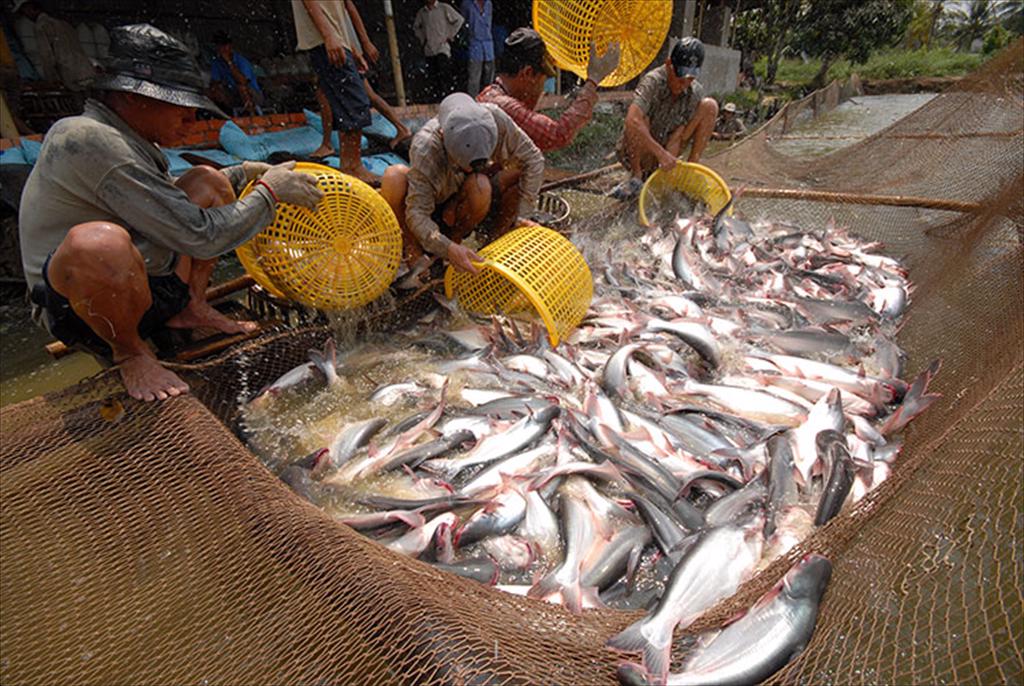
China and the U.S. continue to grow while Brazil slows down
China remained Vietnam’s largest pangasius import market with impressive results. In April 2026, exports to this market reached USD 53 million, up 26% year-on-year. Total exports in the first four months climbed to USD 197 million, accounting for nearly 27% of total pangasius exports and increasing by 54% — the strongest growth rate among major markets. Chinese consumer demand recovered quickly after a cautious period, while advantages in transportation and bilateral trade relations have been effectively utilized.
The United States ranked second, with April export value reaching USD 39 million, up 20% year-on-year. Cumulative exports through April reached USD 106 million, up 4% — positive but far more modest growth compared to China. Under pressure from the 10% tariff and competition from alternative whitefish suppliers, Vietnamese pangasius exports to the U.S. have recovered after a prolonged period of negative growth. However, Vietnamese pangasius products in the U.S. market continue to face significant challenges and competition from other whitefish products.
Brazil, the largest pangasius consumption market in Latin America, recorded export turnover of USD 17 million in April, up 13% year-on-year. However, cumulative exports in the first four months of 2026 reached only USD 57 million, down 7% compared to the same period in 2025.
EU posts slight growth, CPTPP continues to accelerate
Total pangasius exports to the EU from January to April 2026 reached USD 57 million, down 4% year-on-year. In April alone, exports to the EU reached USD 17 million, up slightly by 5%, indicating gradual recovery toward the end of the period.
From the beginning of the year through April 2026, the CPTPP bloc maintained strong growth momentum, with total exports to member markets reaching USD 128 million, up 21% year-on-year.
Frozen fillets continue to dominate
Regarding product structure in the first four months of 2026, frozen pangasius products under HS03 accounted for 98% of total export turnover. Of this, frozen fillets (HS0304) reached USD 594 million, accounting for more than 82% of the industry’s total export value and rising 20%, continuing to be the core product of Vietnamese pangasius in international markets. In contrast, value-added pangasius products under HS16 contributed only USD 13 million, accounting for less than 2% of total exports and declining 16% — indicating that the high value-added segment has yet to be effectively developed.
Vietnam’s pangasius export performance in the first four months of 2026 shows that the industry is maintaining positive growth momentum, driven mainly by China and the CPTPP markets.
Although exports to the EU and Brazil have shown signs of slowing in the short term, this may also create opportunities for enterprises to restructure markets, improve product quality, and enhance adaptability to increasingly stringent import requirements. At the same time, the HS16 processed product segment still holds considerable growth potential. As global demand for convenient and value-added food products continues to rise, this segment could become an important driver for increasing export value and improving profit margins for the pangasius industry in the coming years.
However, alongside the positive signals, businesses should also pay attention to several market uncertainties in the coming period, including the increasing use of trade defense measures, exchange rate fluctuations, and rising international logistics costs. In this context, market diversification, increasing the share of value-added products, and investing more in sustainable farming areas will remain key strategies for enhancing resilience and maintaining long-term growth for Vietnam’s pangasius industry.
(seafood.vasep.com.vn) Vietnamese seafood exports recorded impressive growth, generating nearly 6 billion USD in revenue during the first six months of the year, up 13% compared with the same period last year.
(seafood.vasep.com.vn) Fishermen in Ha Tinh are gradually overcoming difficulties to maintain the efficiency of seafood exploitation. In the first six months of 2026, the entire province achieved a production of more than 23,000 tons of seafood, worth more than 1,200 billion VND.
(seafood.vasep.com.vn) June 2026 brought encouraging signs for Vietnam's tuna exports, with export value rising 20% year-on-year to nearly USD 72 million. However, this increase has yet to offset the prolonged slowdown seen in key markets such as the European Union (EU), where import demand remains weak. The outlook for the second half of the year is expected to become more challenging as freight rates continue to climb.
(vasep.com.vn) As part of the Vietnam Fisheries International Exhibition (Vietfish 2026), the Vietnam Association of Seafood Exporters and Producers (VASEP), in collaboration with the Agency for Domestic Market Management and Development under the Ministry of Industry and Trade, will organize the Domestic Seafood Supply–Demand Matching Program on the morning of August 20, 2026, at the Saigon Exhibition and Convention Center (SECC), Ho Chi Minh City. The program aims to foster direct business connections between Vietnamese seafood producers and processors and domestic distributors, retailers, and foodservice channels.
(seafood.vasep.com.vn) The Cooking Show will be one of the most engaging experiential highlights of Vietfish 2026. Taking place over three days, from August 19–21, 2026, at Hall B1, SECC, Ho Chi Minh City, the event will offer visitors a vibrant culinary space where Vietnamese seafood is showcased through its flavors, stories, and real-life culinary applications.
(seafood.vasep.com.vn) Vietnam's pangasius exports reached USD 205 million in June 2026, up 5% compared with the same month in 2025. Cumulative export value for the first six months of the year totaled USD 1.1 billion, an increase of 12% year-on-year. Growth was primarily driven by strong demand from China and CPTPP markets, while exports to the United States and Brazil continued to decline.
(seafood.vasep.com.vn) In the first six months of 2026, Ha Tinh province continued to implement comprehensive solutions to combat IUU fishing; strictly manage the fishing fleet, control fishing vessels entering and leaving ports, operate vessel tracking devices, trace the origin of seafood, and severely punish violations.
(seafood.vasep.com.vn) Vietnam's tilapia exports reached USD 7 million in June 2026, down 32% compared with the same month in 2025. Nevertheless, thanks to strong growth in the first five months of the year, cumulative tilapia exports in the first half of 2026 totaled USD 69 million, up 67% year on year.
(seafood.vasep.com.vn) Sa Giang Import-Export Joint Stock Company, a member of the Vietnam Association of Seafood Exporters and Producers (VASEP), has been honored with the "Famous Brand - Competitive Vietnamese Brand 2026" certification at an award ceremony organized by the Vietnam Intellectual Property Association (VIPA).
(seafood.vasep.com.vn) China imported nearly $1.4 billion worth of Vietnamese seafood in the first half of the year, a 40% increase compared to the same period last year, surpassing the US to become the largest export market for the industry.
VASEP - HIỆP HỘI CHẾ BIẾN VÀ XUẤT KHẨU THỦY SẢN VIỆT NAM
Chịu trách nhiệm: Ông Nguyễn Hoài Nam - Phó Tổng thư ký Hiệp hội
Đơn vị vận hành trang tin điện tử: Trung tâm VASEP.PRO
Trưởng Ban Biên tập: Bà Phùng Thị Kim Thu
Giấy phép hoạt động Trang thông tin điện tử tổng hợp số 138/GP-TTĐT, ngày 01/10/2013 của Bộ Thông tin và Truyền thông
Tel: (+84 24) 3.7715055 – (ext.203); email: kimthu@vasep.com.vn
Trụ sở: Số 7 đường Nguyễn Quý Cảnh, Phường An Phú, Quận 2, Tp.Hồ Chí Minh
Tel: (+84) 28.628.10430 - Fax: (+84) 28.628.10437 - Email: vasephcm@vasep.com.vn
VPĐD: số 10, Nguyễn Công Hoan, Ngọc Khánh, Ba Đình, Hà Nội
Tel: (+84 24) 3.7715055 - Fax: (+84 24) 37715084 - Email: vasephn@vasep.com.vn