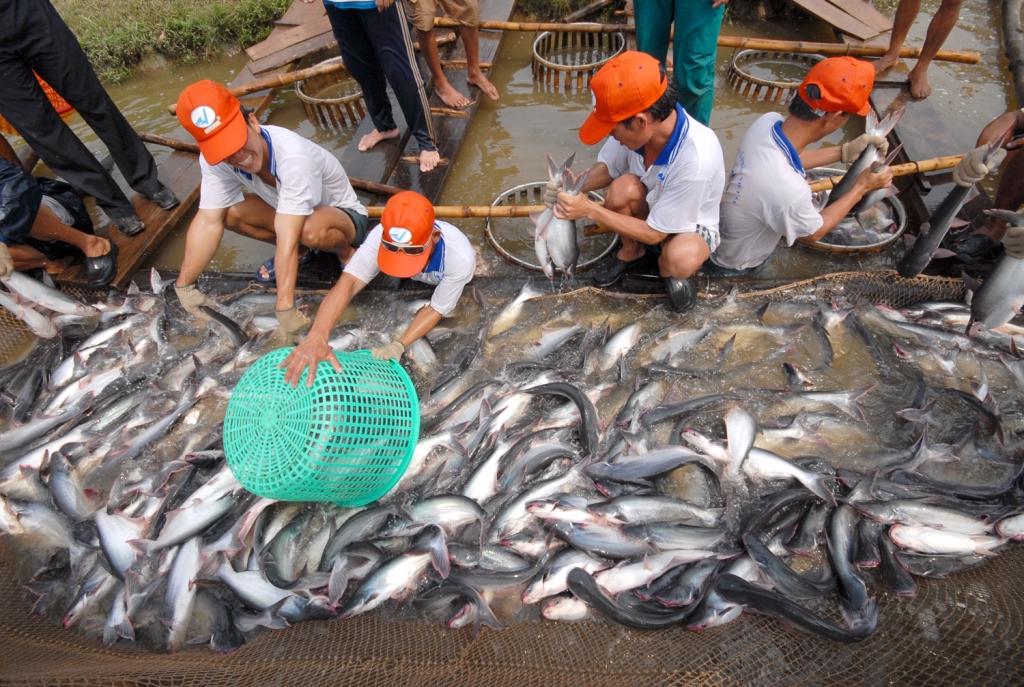
According to experts, farming pangasius in brackish and coastal waters is not a new concept. Several studies and pilot models have shown that pangasius can adapt to saline environments within certain limits. This opens up prospects for reducing pressure on traditional farming areas in the Mekong Delta while making use of the region’s vast untapped coastal water surfaces.
However, the biggest challenge at present is the lack of synchronized infrastructure and suitable farming technologies. Offshore or brackish-water pangasius farming requires cage systems, environmental management, and technical processes that differ significantly from traditional pond farming. In addition, salt-tolerant fingerlings are still in the research stage and are not yet capable of meeting large-scale production demand.
Beyond technical issues, market concerns are also emerging. Businesses believe that if offshore pangasius farming is to expand, the industry must develop a distinct product strategy targeting higher-value market segments rather than directly competing with existing freshwater supply.
Many experts view offshore pangasius farming as a promising long-term trend, especially as climate change and saltwater intrusion continue to intensify in the Mekong Delta. However, achieving this goal will require stronger support policies for breeding research, investment credit, farming area planning, and market linkages in order to build a sustainable foundation for the future development of Vietnam’s pangasius industry.
(seafood.vasep.com.vn) Vietnam’s tilapia industry is maintaining strong growth momentum, with significant room for further expansion in the coming years. In 2025, total tilapia production reached approximately 420,000 tonnes, up 33% from 2024 and 2.2 times higher than in 2015. During 2015–2025, production grew at an average annual rate of around 8.4%. As production and exports continue to expand, food safety control is receiving increasing attention to ensure product quality, meet the increasingly stringent requirements of international markets, and provide a foundation for the sustainable development of Vietnam’s tilapia industry.
(seafood.vasep.com.vn) On the afternoon of August 19, 2026, as part of the Vietnam International Seafood Exhibition – Vietfish 2026, the Hosted Buyer Program continued with the seminar “Vietnam Seafood Outlook 2026–2027: A Strategic Sourcing Destination,” followed by 1-to-1 B2B meetings between international buyers and Vietnamese seafood businesses.
(seafood.vasep.com.vn) Speaking at the Opening Ceremony of VIETFISH 2026 on August 19 at the Saigon Exhibition and Convention Center (SECC), U.S. Consul General Melissa Brown highlighted the important role of the exhibition in connecting Vietnam’s growing seafood industry with buyers, suppliers, and partners from the United States and around the world.
(vasep.com.vn) Tomorrow, August 19, 2026, the Vietnam International Seafood Exhibition – Vietfish 2026 will officially open at the Saigon Exhibition and Convention Center (SECC) in Ho Chi Minh City. Taking place over three days, from August 19–21, Vietfish 2026 promises to provide a dynamic platform for business networking, trend updates, product experiences and comprehensive cooperation across the domestic and international seafood community.
(vasep.com.vn) The global tilapia market continues to grow, creating significant opportunities for countries with strengths in aquaculture, processing, and exports. Against this backdrop, Vietnam’s tilapia industry is gradually developing toward higher quality, greater product diversification, and broader market reach. At Vietfish 2026, the Vietnam Association of Seafood Exporters and Producers (VASEP), together with the VASEP Tilapia Producers and Exporters Club, will host a joint booth to promote the image and potential of Vietnamese tilapia to domestic and international buyers.
(seafood.vasep.com.vn) Vietnam’s seafood exports are heading towards $12 billion this year, potentially the highest level on record. Yet one of the country’s export strengths is facing a growing list of challenges.
(seafood.vasep.com.vn) The first six months of 2026 indicate that Vietnam’s tilapia industry is entering a new phase of development, with strong export growth but also greater demands for production scale, quality and international competitiveness.
(seafood.vasep.com.vn) Vietfish 2026, the Vietnam International Seafood Exhibition, will officially take place from 19–21 August 2026 in Ho Chi Minh City. As Vietnam’s largest annual seafood trade event, organized by the Vietnam Association of Seafood Exporters and Producers (VASEP), Vietfish 2026 will once again bring together leading seafood companies, industry experts, and international partners from across the global seafood value chain.
(seafood.vasep.com.vn) Vietnam’s seafood exports reached USD 1.1 billion in July 2026, up 4.8% compared to the same period in 2025. Cumulative exports in the first seven months of the year totaled nearly USD 6.86 billion, an increase of 11.5% year-on-year. Exceeding the USD 1 billion mark in July further reinforces the prospect that Vietnam’s seafood exports could surpass USD 12 billion in 2026. However, the July figures also send a clear signal that the most favorable growth period may have passed: overall export growth slowed to just 4.8%, pangasius exports fell 6.1%, tuna exports were virtually flat, while exports to the EU, South Korea, and the Middle East all recorded double-digit declines.
(vasep.com.vn) As part of the Vietnam Fisheries International Exhibition (Vietfish 2026), the seminar "Global Seafood Market and the Future Workforce: Trends, Opportunities, and Sustainable Development Pathways for Vietnam's Seafood Industry" will take place from 2:00 p.m. to 4:15 p.m. on August 19, 2026, at Convention Room B, Level 2, SECC, Ho Chi Minh City. This is the first of five specialized seminars at Vietfish 2026, focusing on key issues that are shaping the long-term development of Vietnam's seafood industry.
VASEP - HIỆP HỘI CHẾ BIẾN VÀ XUẤT KHẨU THỦY SẢN VIỆT NAM
Chịu trách nhiệm: Ông Nguyễn Hoài Nam - Phó Tổng thư ký Hiệp hội
Đơn vị vận hành trang tin điện tử: Trung tâm VASEP.PRO
Trưởng Ban Biên tập: Bà Phùng Thị Kim Thu
Giấy phép hoạt động Trang thông tin điện tử tổng hợp số 138/GP-TTĐT, ngày 01/10/2013 của Bộ Thông tin và Truyền thông
Tel: (+84 24) 3.7715055 – (ext.203); email: kimthu@vasep.com.vn
Trụ sở: Số 7 đường Nguyễn Quý Cảnh, Phường An Phú, Quận 2, Tp.Hồ Chí Minh
Tel: (+84) 28.628.10430 - Fax: (+84) 28.628.10437 - Email: vasephcm@vasep.com.vn
VPĐD: số 10, Nguyễn Công Hoan, Ngọc Khánh, Ba Đình, Hà Nội
Tel: (+84 24) 3.7715055 - Fax: (+84 24) 37715084 - Email: vasephn@vasep.com.vn