China & Hong Kong remained the strongest growth driver for Vietnam’s shrimp exports during the period. Export value to this market exceeded USD 711 million, up 46% year-on-year and accounting for nearly 38% of the country’s total shrimp export turnover. Stable demand for frozen shrimp products, together with robust growth in lobster exports, helped boost shipments to this market.
Meanwhile, the United States—which had long been Vietnam’s leading shrimp market—continued to be a bottleneck for the industry. Shrimp exports to the U.S. totaled USD 228 million in the first five months of the year, down 22% compared with the same period last year. In addition to intense price competition from Ecuador and India, exporters are closely monitoring developments related to the Section 301 investigation and anti-dumping duties. These factors have made U.S. buyers increasingly cautious in their purchasing decisions.
Other traditional markets showed relatively stable performance. Exports to Japan and South Korea remained largely unchanged from a year earlier, while the EU maintained modest growth. Markets such as Australia, the United Kingdom, Canada, and Taiwan continued to post encouraging growth, helping diversify export destinations for Vietnamese shrimp products.
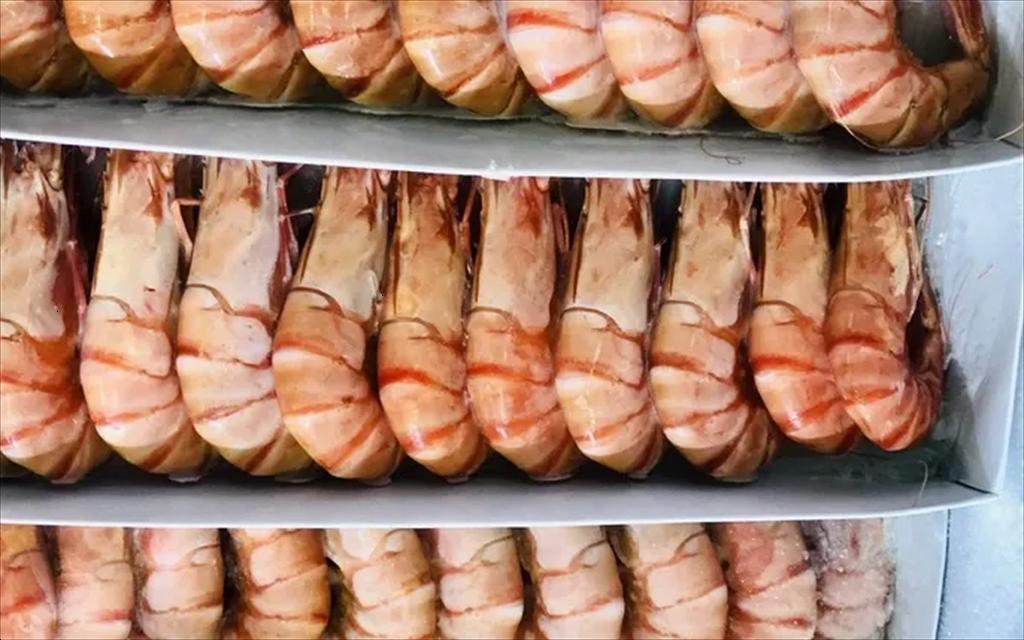
By product category, whiteleg shrimp remained dominant, accounting for more than 57.1% of total shrimp export value, while black tiger shrimp represented 9.5%. The category of other marine shrimp recorded the highest growth rate, rising 29% year-on-year, reflecting both supply diversification and growing market demand for alternatives to traditional whiteleg shrimp.
Despite positive market signals, the shrimp industry continues to face production-related challenges. In recent weeks, farm-gate shrimp prices in many Mekong Delta provinces have declined amid increasing supply. This price drop has occurred while production costs continue to rise, including feed, seedstock, packaging, logistics, and sharply higher ocean freight rates.
Nevertheless, the outlook is not without bright spots. Demand across many Asian markets remains positive, while several international macroeconomic factors have become more favorable compared with the beginning of the year. Easing geopolitical tensions in the Middle East, following positive developments in U.S.–Iran relations, have helped reduce concerns over disruptions to global supply chains and international shipping. If this trend continues, logistics cost pressures could ease in the coming months.
As a result, the outlook for Vietnam’s shrimp exports in the second half of 2026 remains cautiously optimistic. Growth momentum from China and other Asian markets is expected to continue, while Vietnamese companies are accelerating the development of value-added processed products, improving production efficiency, and expanding into new markets to reduce dependence on a limited number of destinations.
After the first five months of the year, Vietnam’s shrimp industry has demonstrated its resilience and adaptability amid global market fluctuations. Although challenges related to costs and competition remain, the sector’s double-digit growth provides a solid foundation for achieving further expansion during the remainder of 2026.
(seafood.vasep.com.vn) Although Germany’s tuna imports have declined, Vietnam’s tuna exports to the market continue to show positive signs. Notably, export value recovered strongly in Q3/2026, and German import data also show Vietnamese products strengthening their position amid competition among suppliers.
(seafood.vasep.com.vn) Seafood exports are holding double-digit growth, but the opportunities are not spread evenly across product groups and markets. As businesses draw up their plans for 2027, Vietnam Seafood Summit 2026 (VSS2026) offers a chance to look ahead together: what to sell, where to sell it, and how to prepare for growth in the coming years.
(seafood.vasep.com.vn) With less than two weeks to go, the Vietnam Seafood Summit 2026 (VSS 2026) will officially take place in Can Tho. Under the theme “Seafood Market Outlook 2027–2029 – Opportunities and Potential for Double-Digit Export Growth,” the Summit is organized by VASEP at a time when seafood businesses are facing rapid market shifts, changing buyer demand, trade policy changes and growing competitive pressure all at once.
(seafood.vasep.com.vn) On October 28, 2026, the China Fisheries & Seafood Expo opened in Qingdao, China. The expo takes place over three days from October 28 to 30, 2026. This is a prestigious specialized seafood exhibition organized annually by Sea Fare Exposition Inc.
(vasep.com.vn) In the first nine months of 2026, Vietnam’s tilapia exports to the CPTPP bloc reached $7 million, marking a 51% year-on-year increase. The bloc rstands as the fourth-largest market for Vietnamese tilapia, trailing Brazil, the US, and Saudi Arabia.
(vasep.com.vn) VASEP has officially announced the program for Vietnam Seafood Summit 2026 (VSS 2026), featuring five in-depth sessions covering industry outlooks, trade barriers, buyer demand, the domestic market, and solutions to improve productivity and reduce costs across the seafood value chain.
(vasep.com.vn) Vietnam’s shrimp exports reached US$3.7 billion in the first nine months of 2026, up 11% year on year. Although growth has been supported by China and several markets within the CPTPP, momentum is slowing as exports to the United States and the European Union decline. Tariff pressures, international competition, and raw material challenges are creating significant hurdles for exporters in the final months of the year.
(vasep.com.vn) Markets are changing faster, buyer requirements are becoming more demanding, and trade barriers are growing increasingly complex. In this environment, seafood businesses need more than an understanding of current market conditions. They need a longer-term perspective to answer a critical question: Where will growth opportunities come from in 2027–2029, and what should businesses do now to prepare? This is one of the key reasons why VASEP is organizing Vietnam Seafood Summit 2026.
(vasep.com.vn) In the first eight months of 2026, Vietnam’s pangasius exports to the Middle East reached US$113 million, up 7% year on year from the same period in 2025. Growth has become more pronounced in recent months. In August alone, exports to the region totaled US$20 million, an increase of 24%. This indicates that demand for Vietnamese pangasius in the Middle East is gradually recovering after a slowdown in March, although the pace of recovery varies across markets.
(vasep.com.vn) China’s shrimp imports continued to grow strongly in 2026, while Vietnam’s shrimp exports to the market also recorded notable growth. However, behind these positive figures lie two distinct trends: Chinese consumption is growing more slowly than imports, and lobster accounts for a substantial share of Vietnam’s shrimp exports to China, making its product mix significantly different from those of Ecuador and India. Exporters therefore need to assess each segment carefully to understand the opportunities and risks.
VASEP - HIỆP HỘI CHẾ BIẾN VÀ XUẤT KHẨU THỦY SẢN VIỆT NAM
Chịu trách nhiệm: Ông Nguyễn Hoài Nam - Phó Tổng thư ký Hiệp hội
Đơn vị vận hành trang tin điện tử: Trung tâm VASEP.PRO
Trưởng Ban Biên tập: Bà Phùng Thị Kim Thu
Giấy phép hoạt động Trang thông tin điện tử tổng hợp số 138/GP-TTĐT, ngày 01/10/2013 của Bộ Thông tin và Truyền thông
Tel: (+84 24) 3.7715055 – (ext.203); email: kimthu@vasep.com.vn
Trụ sở: Số 7 đường Nguyễn Quý Cảnh, Phường An Phú, Quận 2, Tp.Hồ Chí Minh
Tel: (+84) 28.628.10430 - Fax: (+84) 28.628.10437 - Email: vasephcm@vasep.com.vn
VPĐD: số 10, Nguyễn Công Hoan, Ngọc Khánh, Ba Đình, Hà Nội
Tel: (+84 24) 3.7715055 - Fax: (+84 24) 37715084 - Email: vasephn@vasep.com.vn