According to the trend, only a few markets kept positive growth in pangasius imports such as Germany, Saudi Arabia, and the UK, while most of the major markets decreased, including Russia.
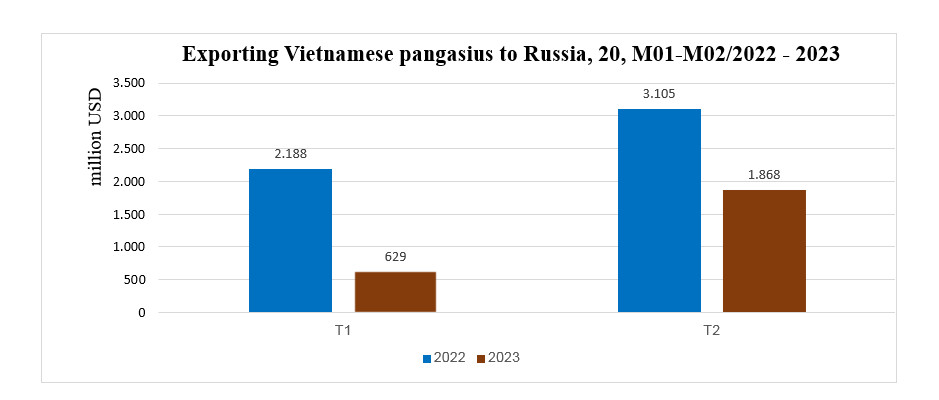
In February 2023, pangasius exports to the Russian market reached nearly 2 million USD, down 40% over the same period last year (equivalent to 3 million USD) and accounted for 1% of the total value of Vietnamese pangasius to other markets. .
In the first two months of 2023, Vietnam's pangasius to the Russian market reached nearly $2.5 million, down 53% compared to the same period in 2022 and accounted for 1.4% of the total value of Vietnamese pangasius exports to markets. The proportion of the Russian market in the first 2 months of this year increased higher than the same period last year (only 1%). Although pangasius decreased, the context of inflation reduced demand and decreased import prices, sales by the end of February are also a positive sign.
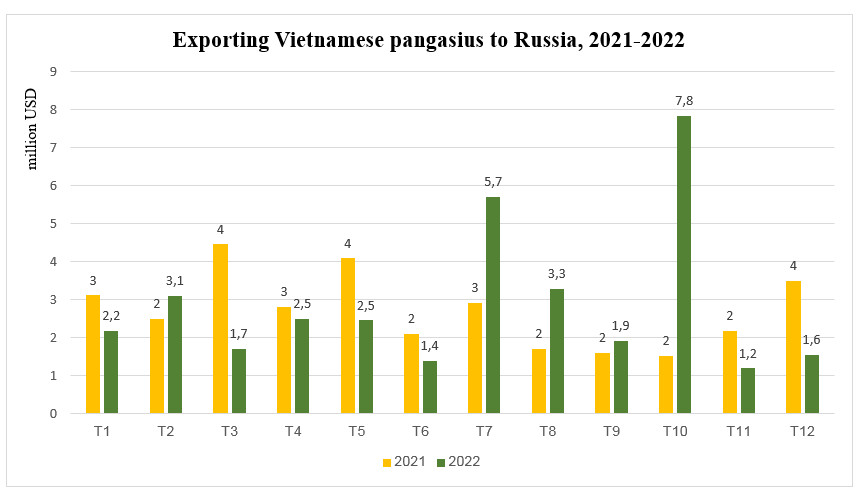
The conflict between Russia and Ukraine since the end of February 2022 has greatly affected world trade, including Vietnam, causing traffic congestion and difficult trade payments. Although the proportion of Vietnam's seafood exports to these two countries is not large, the escalating tension also creates chain consequences, affecting the seafood exports of the countries. Therefore, in the period of March and April, 2022, Vietnam's seafood exports to Russia stagnated, decreasing by 86% and 46% respectively.
When the war between Russia and Ukraine occurred, Russia was embargoed, Vietnamese goods exported to Russia were also delayed for 3 months, some orders had to be returned, businesses had to process goods. exist or seek to export to other markets. Currently 1 year after the war between Russia and Ukraine, Vietnamese pangasius to the Russian market is showing positive signs of recovery. From the end of 2022, Russia has accelerated the import of Vietnamese pangasius.
In the context of inflation, the Russian market is also not affected as much as Western countries. In addition, Russia is promoting seafood trade with other countries, including China, India and Bangladesh. Vietnamese seafood more or less also has to compete with other countries, especially China, on the Russian market. The Russian economy will be more dependent on China because of the common border. However, Vietnam is still the number one source of pangasius in Russia.
It is forecasted that in the following months, the volume of pangasius to Russia may increase slightly. However, the price of pangasius to this market will decrease compared to 2022, following the general trend. Moreover, Russia's food price inflation is cooling down month by month, which has a negative impact on the prices of the country's seafood products.
According to Russian statistics, from March 13 to March 19, the prices of frozen fish products were stable, sometimes decreasing. In the Far East, pollock prices fell 2.1% (95₽/kg), Pacific herring 3.2% (60₽/kg). Prices of Pacific cod and halibut remained at the level of last week - 220₽ and 70₽/kg. In the Northwest, Atlantic herring decreased by 3.1% (93₽/kg). The price of mackerel remains unchanged: 167₽/kg.
In the central regions, the price of capelin fell 3.4% to 85₽/kg. Atlantic herring fell 1.7% to 113₽/kg. Pollock prices remained at the level of last week - 118₽/kg.
Thu Hang
(seafood.vasep.com.vn) A project titled "Sustainable Shrimp Industry Governance" has been launched in Ca Mau Province with the aim of supporting the transition of the province's shrimp industry toward higher quality, lower emissions, stronger governance capacity, improved supply chain traceability, and the development of a sustainable shrimp brand that meets the increasingly stringent requirements of export markets.
(seafood.vasep.com.vn) Khanh Hoa Provincial Agricultural Extension Center, in collaboration with the Northern Center for Marine Aquaculture Research and the Van Hung Public Service Center, recently organized a training course on disease-free golden pompano seed production. The program is part of a National Agricultural Extension Project aimed at developing industrial-scale seed production models to support sustainable marine aquaculture.
(seafood.vasep.com.vn) Vietnam’s pangasius exports have shown encouraging signs of recovery in 2026. In the first four months of the year, total export turnover reached USD 720 million, up 17% compared to the same period last year. This result reflects improving demand across many markets, as well as the efforts of Vietnamese pangasius enterprises to maintain production, secure orders, and adapt to changing market conditions.
(seafood.vasep.com.vn) The application of high technology in shrimp farming is delivering positive results in the coastal areas of Vinh Long Province, contributing to improved production efficiency and creating significant potential for further industry expansion. However, to fully capitalize on this potential, the province is focusing on aquaculture zoning, infrastructure investment, and promoting modern, sustainable production.
(seafood.vasep.com.vn) Đồng Tháp Province has intensified efforts to curb illegal fishing by strengthening vessel monitoring, law enforcement and seafood traceability.
(seafood.vasep.com.vn) Seafood businesses need solutions to overcome bottlenecks such as labor shortages, difficulty accessing capital, high input costs, and administrative procedures in order to maintain production, adapt to market fluctuations, and effectively exploit export opportunities.
(seafood.vasep.com.vn) The FTA would widen access to markets with strong demand for premium food products in line with the country’s strategy of shifting exports towards increasing added value.
(seafood.vasep.com.vn) On the morning of July 13th, Mr. Ho Quoc Dung, Member of the Central Committee of the Communist Party of Vietnam and Deputy Prime Minister, along with his delegation, visited and worked with businesses in An Giang province to promptly resolve obstacles and promote production and business activities.
(seafood.vasep.com.vn) As importing markets increasingly focus on biosecurity and traceability, Vietnam has established a relatively comprehensive legal framework and disease management system for aquaculture, covering tilapia farming as well as other cultured species. This system is based on the Law on Animal Health, regulations on the prevention and control of aquatic animal diseases, the National Plan for the Prevention and Control of Major Diseases in Farmed Aquatic Species, and environmental monitoring and early warning programs for aquaculture areas.
(seafood.vasep.com.vn) On July 9, 2026, the Embassy of Vietnam in Brazil organized the seminar titled “Sharing Information on Vietnam-Brazil Economic, Trade and Investment Relations in the First Half of 2026” to provide updates on bilateral cooperation and strengthen connections among government agencies, industry associations, and business communities of the two countries.
VASEP - HIỆP HỘI CHẾ BIẾN VÀ XUẤT KHẨU THỦY SẢN VIỆT NAM
Chịu trách nhiệm: Ông Nguyễn Hoài Nam - Phó Tổng thư ký Hiệp hội
Đơn vị vận hành trang tin điện tử: Trung tâm VASEP.PRO
Trưởng Ban Biên tập: Bà Phùng Thị Kim Thu
Giấy phép hoạt động Trang thông tin điện tử tổng hợp số 138/GP-TTĐT, ngày 01/10/2013 của Bộ Thông tin và Truyền thông
Tel: (+84 24) 3.7715055 – (ext.203); email: kimthu@vasep.com.vn
Trụ sở: Số 7 đường Nguyễn Quý Cảnh, Phường An Phú, Quận 2, Tp.Hồ Chí Minh
Tel: (+84) 28.628.10430 - Fax: (+84) 28.628.10437 - Email: vasephcm@vasep.com.vn
VPĐD: số 10, Nguyễn Công Hoan, Ngọc Khánh, Ba Đình, Hà Nội
Tel: (+84 24) 3.7715055 - Fax: (+84 24) 37715084 - Email: vasephn@vasep.com.vn