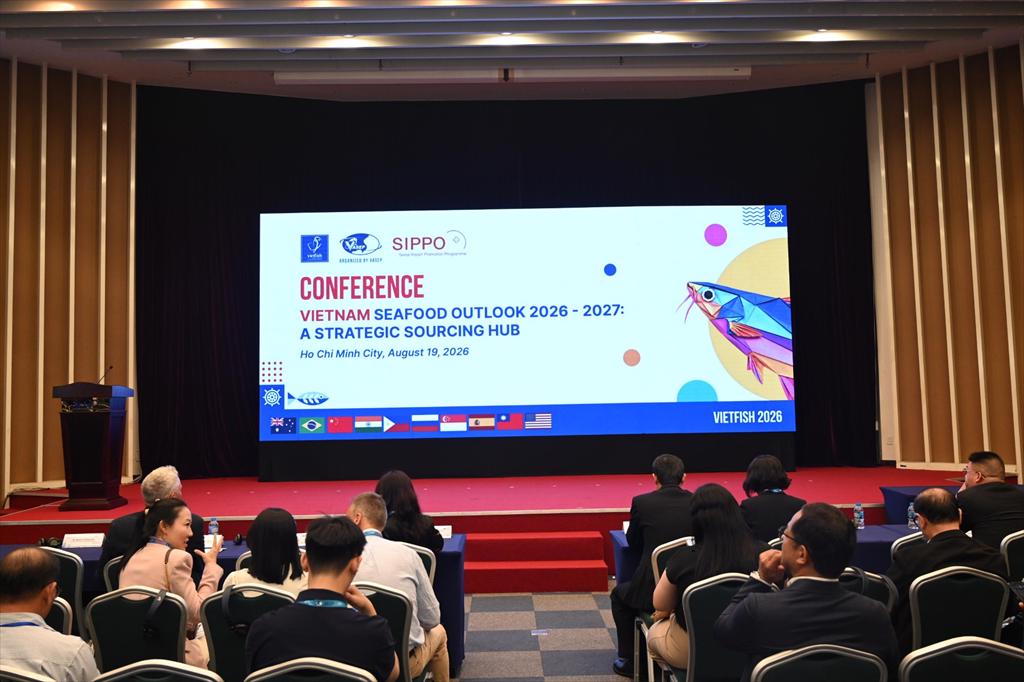
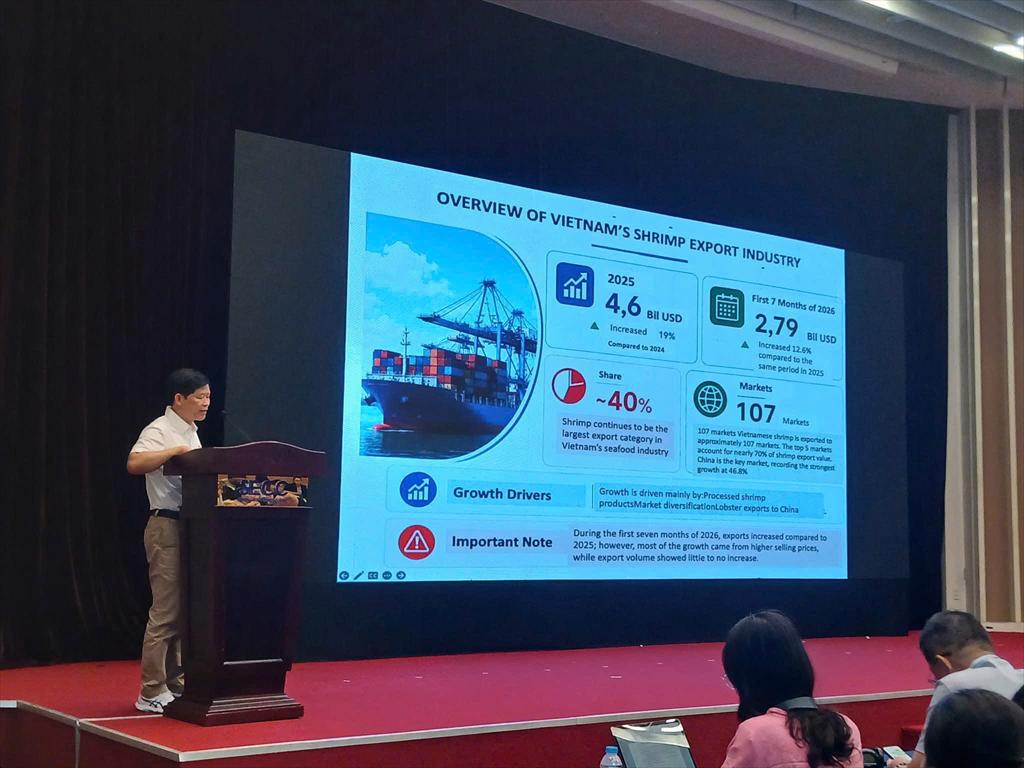
According to the presentation, shrimp remains Vietnam’s largest seafood export commodity, accounting for approximately 40% of total seafood export value. In 2025, Vietnam’s shrimp exports reached US$4.6 billion, up 19% from 2024. In the first seven months of 2026, shrimp exports reached US$2.79 billion, up 13.5% year on year. Vietnamese shrimp is currently exported to around 107 markets, with the five largest markets accounting for nearly 70% of total export value.
These figures show that Vietnam’s shrimp industry continues to benefit from a broad market base and retain its ability to grow amid considerable volatility in global seafood trade. However, an important point is that growth during the first seven months was driven primarily by higher selling prices, while export volumes did not increase at the same pace. This reflects a reality that warrants careful consideration: growth in export value does not necessarily translate into sustainable improvements in output, profitability or competitiveness.
Vietnam’s Strength Lies in Value-Added Processing
In the global competitive landscape, each major shrimp-exporting country has its own distinct advantage. Ecuador benefits from large-scale farming and low production costs; India is strong in raw and frozen shrimp; while Indonesia is investing heavily in high-tech aquaculture and focusing on the US market. Vietnam, meanwhile, is seen as having an advantage in value-added processing and the ability to serve a wide range of market segments.
This is a key differentiating factor for Vietnamese shrimp. While many competitors compete on scale, volume and low prices, Vietnamese companies have strengths in deep processing, convenience products, customized products, order flexibility, and extensive experience in meeting quality standards across multiple importing markets.
However, this advantage is not permanent. As markets increasingly emphasize transparency, sustainability certification, traceability, social responsibility and carbon emissions, processing capacity alone represents only one part of competitiveness. To retain orders, companies must demonstrate that their entire supply chains are reliable—from farming areas and raw materials to processing plants and finished products.
Global Competition Is Shifting from Volume to Efficiency and Standards
Mr. Pham’s presentation also highlighted notable developments among major shrimp-exporting countries. Ecuador is an example of restructuring as prolonged low selling prices put pressure on both businesses and farmers. Many smaller processing plants have had to be sold or merged, while larger companies have expanded farming areas and integrated their supply chains. Production growth is beginning to show signs of slowing, while competition is gradually shifting toward efficiency and scale.
India is also facing pressure as shrimp prices decline while input costs rise. Farmers are reducing farming areas or stocking densities, while competition from Ecuador in the US and Chinese markets is becoming increasingly intense. At the same time, India is increasing investment in broodstock, biosecurity and high-tech aquaculture.
These developments offer an important lesson for Vietnam. If the industry focuses solely on short-term export growth, it may overlook deeper changes taking place in the structure of global competition. Competitors are not competing on price alone; they are restructuring supply chains, strengthening control over raw material supplies, investing in technology and improving production efficiency.
International Buyers Are Setting New Requirements
The global shrimp market is also changing significantly from the consumer and buyer perspective. Consumption trends are shifting more strongly toward convenient, ready-to-cook and easy-to-use products. Consumers are paying greater attention to health and food safety, while sustainability is increasingly influencing purchasing decisions. At the same time, requirements for traceability and supply-chain transparency are becoming more stringent.
For international buyers, new expectations include electronic traceability systems, sustainability certification, compliance with labor, environmental and social responsibility requirements, as well as the measurement and reduction of carbon emissions.
This means Vietnamese shrimp can no longer compete solely on product quality at the processing plant. Market access in the coming period will depend increasingly on data, documentation, certification, transparency, supply-chain management capabilities, and the ability to demonstrate responsibility toward the environment, workers, communities and consumers.
Domestic Pressures Facing Vietnam’s Shrimp Industry
In addition to market requirements, Vietnam’s shrimp industry is also facing a number of internal pressures. At the farming stage, the costs of feed, electricity, fuel and other inputs are rising; disease outbreaks are becoming more frequent; electricity, irrigation, transport and logistics infrastructure remains uneven; climate change is increasing production risks; and raw shrimp prices remain volatile.
At the processing stage, exports continue to grow, but domestic raw material supplies remain unstable. Fluctuating raw material prices are causing many farmers to reduce stocking densities or leave ponds idle. Processing capacity at factories continues to expand while raw material supplies remain limited and access to markets is increasingly subject to multiple standards. Companies are also facing labor shortages, rising production costs and declining profit margins despite higher export values.
This is a major bottleneck for Vietnam’s shrimp industry. Without stabilizing farming areas and raw material supplies, the full potential of Vietnam’s value-added processing advantage will be difficult to realize. A strong processing sector must be built on a foundation of stable raw materials, controlled production and genuine supply-chain linkages.
Change Is a Prerequisite for Sustainable Development
The concluding message of Mr. Pham’s presentation was particularly noteworthy: Vietnamese shrimp businesses view change not as an option, but as a prerequisite for growth and development. Vietnam will focus on its strengths in processing capacity, product quality and its ability to meet market requirements in order to supply clean, green, safe and responsible seafood products. The long-term goal is to become a trusted and responsible global shrimp supplier.
From a market perspective, this is also the most appropriate direction for Vietnamese shrimp. In competing with Ecuador, India and Indonesia, Vietnam is unlikely to succeed by simply pursuing lower prices or larger volumes. Its competitive advantage needs to be reinforced through deep processing, value-added products, flexible order fulfillment, quality control, traceability and the development of more sustainable raw material supply chains.
In other words, Vietnam’s shrimp industry needs to shift from thinking “export more” to “retain more value”; from competing for short-term orders to building long-term trust; from fragmented production to supply-chain integration; and from simply meeting market requirements to proactively standardizing and upgrading its capabilities.
Shrimp remains the largest pillar of Vietnam’s seafood exports. But to maintain that position, the industry can no longer rely on its traditional advantages. The next phase will be a competition based on efficiency, transparency, technology, responsibility and value addition. With its established processing capabilities, Vietnam’s shrimp industry still has a strong opportunity to consolidate its position as a reliable source of supply in the global shrimp trade—provided it can effectively address the challenges of raw material supply, supply-chain integration and the evolving requirements of international buyers.
(vasep.com.vn) Vietfish 2026 was more than just a larger exhibition space. Through B2B meetings, booth discussions, production-chain visits and post-show feedback, businesses and buyers found something more concrete: suitable suppliers, processing capabilities, technology solutions, new markets and a foundation for building long-term trust and partnerships.
(vasep.com.vn) Vietnam’s tilapia exports to the United States declined significantly in the first seven months of 2026. Cumulative export value reached US$18 million, down 42% from the same period in 2025. In July alone, exports amounted to just US$2 million, plunging 70%, indicating a clear slowdown in import demand from the US market.
(vasep.com.vn) At the seminar “Global Seafood Markets and the Future Workforce: Trends, Opportunities and Directions for the Sustainable Development of Vietnam’s Fisheries Sector,” held as part of VIETFISH 2026, Ms. Shirlene Maria Anthonysamy, Fisheries Officer (Markets) and GLOBEFISH Coordinator at the Food and Agriculture Organization of the United Nations (FAO), presented initiatives aimed at promoting youth participation in fisheries and aquaculture.
(vasep.com.vn) In the first seven months of 2026, Vietnam’s pangasius exports to the United States reached US$189 million, down 8% year-on-year. In July alone, export value reached US$22 million, down 28%. This trend indicates that U.S. demand for pangasius imports has remained relatively cautious this year, as importers tend to maintain moderate inventory levels and limit stockpiling.
(vasep.com.vn) After three days at the Saigon Exhibition and Convention Center (SECC) in Ho Chi Minh City, the Vietnam International Fisheries Exhibition – VIETFISH 2026 – has successfully concluded, leaving a strong impression in terms of scale, visitor numbers, the quality of business connections, and innovative activities. With more than 14,000 m² of exhibition space, 335 companies, 568 booths, participation from representatives of 17 countries and territories, and nearly 15,000 visitors, VIETFISH 2026 has once again affirmed its role as an important meeting point for Vietnam’s and the global seafood industry.
(seafood.vasep.com.vn) Held as part of Vietfish 2026 from August 19–21 at SECC in Ho Chi Minh City, a series of five specialized seminars provided the seafood business community with updates on markets, technology, standards, human resources and cooperation opportunities. With the participation of experts, international organizations, government agencies and businesses from Vietnam and abroad, the seminars created an additional platform for professional exchange alongside the exhibition’s product showcases and business networking activities.
(seafood.vasep.com.vn) On the morning of August 19, 2026, the Vietnam International Seafood Exhibition – VIETFISH 2026 officially opened at the Saigon Exhibition and Convention Center (SECC) in Ho Chi Minh City. With 568 booths representing 335 companies, alongside the presence of senior government officials, local authorities, diplomatic missions and international partners, VIETFISH 2026 kicks off three days of business networking, technology exchange and market engagement under the overarching theme “Innovation and Sustainability.”
The Vietnam Association of Seafood Exporters and Producers (VASEP) officially announces that the Vietnam International Seafood Exhibition (Vietfish 2026) will take place from August 19–21, 2026, at the Saigon Exhibition and Convention Center (SECC), Ho Chi Minh City.
(seafood.vasep.com.vn) Vietnam’s seafood exports recorded strong growth in the first half of 2026, but the performance was increasingly uneven across products, markets and enterprises. VASEP’s newly released premium report provides the detailed data and analysis needed to understand what lies behind the headline figures and prepare for the more challenging months ahead.
(seafood.vasep.com.vn) Brazil remains one of the key markets for Vietnamese pangasius in South America. However, exports to the market showed signs of slowing in the first half of 2026, while frozen pangasius fillets continued to account for the overwhelming majority of exports.
VASEP - HIỆP HỘI CHẾ BIẾN VÀ XUẤT KHẨU THỦY SẢN VIỆT NAM
Chịu trách nhiệm: Ông Nguyễn Hoài Nam - Phó Tổng thư ký Hiệp hội
Đơn vị vận hành trang tin điện tử: Trung tâm VASEP.PRO
Trưởng Ban Biên tập: Bà Phùng Thị Kim Thu
Giấy phép hoạt động Trang thông tin điện tử tổng hợp số 138/GP-TTĐT, ngày 01/10/2013 của Bộ Thông tin và Truyền thông
Tel: (+84 24) 3.7715055 – (ext.203); email: kimthu@vasep.com.vn
Trụ sở: Số 7 đường Nguyễn Quý Cảnh, Phường An Phú, Quận 2, Tp.Hồ Chí Minh
Tel: (+84) 28.628.10430 - Fax: (+84) 28.628.10437 - Email: vasephcm@vasep.com.vn
VPĐD: số 10, Nguyễn Công Hoan, Ngọc Khánh, Ba Đình, Hà Nội
Tel: (+84 24) 3.7715055 - Fax: (+84 24) 37715084 - Email: vasephn@vasep.com.vn