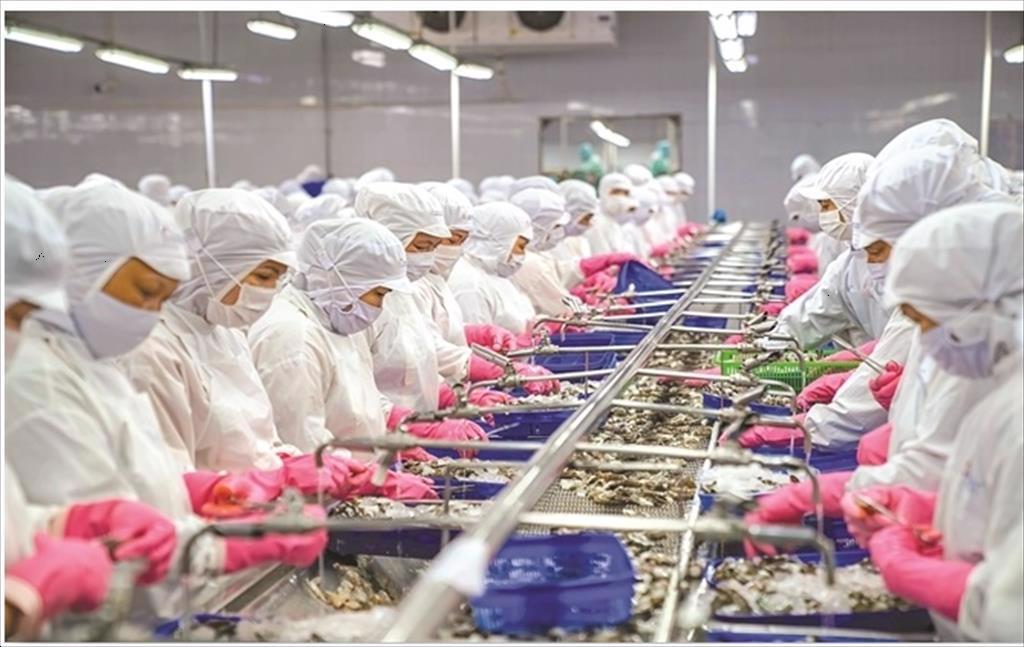
Vinh Hoan stands out as a leader in this sector, employing a sustainable, closed-loop farming model with five subsidiaries focused on various aspects of aquaculture. These include pangasius seed production, aquatic feed, and the extraction of gelatin and collagen, along with a fertilizer production arm. Notably, the gross profit margin for the collagen and gelatin factory can reach up to 30%. Chairwoman Ms. Truong Thi Le Khanh emphasizes that optimizing production processes and minimizing waste enables the company to maximize profits.
Vinh Hoan's circular economic model not only enhances the processing of high-value products from by-products but also supports Vietnam's Net Zero goals. Many prominent seafood companies, such as De Heus, Minh Phu, Thang Long, Vietnam Food, and Skretting, are investing in R&D for aquaculture and seafood processing to lower emissions in line with international commitments.
Promoting the circular economic model over a linear one is seen as a crucial strategy for balancing economic growth with environmental sustainability. Vietnam aims to achieve 10 billion USD in shrimp exports by 2030—three times the current value—projecting an output of approximately 1.1 million tons. The estimated shrimp by-product volume stands at around 500,000 tons. Mr. Phan Thanh Loc, Chairman of Vietnam Food Joint Stock Company, notes that shrimp by-products can yield 20-30 times more value in the pharmaceutical sector or 15-20 times more in the functional food industry. With a shrimp production forecast of over 1.2 million tons in 2023, the potential for increased value from by-products is significant.
Vinh Hoan's circular model has led to remarkable results, with revenue from the collagen and gelatin segment experiencing a compound annual growth rate (CAGR) of 21% from 2018 to 2023, contributing 7% to total revenue in 2023. In contrast, fishmeal and fish fat fetch prices of only 1.2-1.5 USD/kg, while collagen production can yield 15-20 USD/kg for finished products. Overall, leveraging by-products could enhance the value of Vinh Hoan's pangasius farming and processing chain by 15-25%.
Similarly, PAN Group Joint Stock Company is embracing sustainability as a cornerstone of modern agriculture, investing in a recycling production model. By collaborating with a shrimp shell processing company, PAN Group has transformed what would have been costly waste management for over 7,500 tons of shrimp heads and shells into an additional revenue stream of 15 billion VND.
Vietnam generates approximately 170-180 million tons of agricultural by-products annually. With the right processes and technologies for recovery and recycling, these by-products could offer substantial economic benefits while also mitigating environmental waste. The seafood industry aims to ensure that by 2030, all by-products from shrimp and fish processing will be repurposed for circular production.
The experience of Vietnam Food, which processes 35,000-50,000 tons of shrimp by-products each year—boosting their value by 6-8 times—serves as a valuable lesson. Mr. Loc stresses the need for innovative initiatives and a comprehensive industry ecosystem to promote growth. "We believe that today's waste is tomorrow's resource. Achieving this requires strong governmental support, as it represents a new industry," he concludes.
(seafood.vasep.com.vn) Although Germany’s tuna imports have declined, Vietnam’s tuna exports to the market continue to show positive signs. Notably, export value recovered strongly in Q3/2026, and German import data also show Vietnamese products strengthening their position amid competition among suppliers.
(seafood.vasep.com.vn) Seafood exports are holding double-digit growth, but the opportunities are not spread evenly across product groups and markets. As businesses draw up their plans for 2027, Vietnam Seafood Summit 2026 (VSS2026) offers a chance to look ahead together: what to sell, where to sell it, and how to prepare for growth in the coming years.
(seafood.vasep.com.vn) With less than two weeks to go, the Vietnam Seafood Summit 2026 (VSS 2026) will officially take place in Can Tho. Under the theme “Seafood Market Outlook 2027–2029 – Opportunities and Potential for Double-Digit Export Growth,” the Summit is organized by VASEP at a time when seafood businesses are facing rapid market shifts, changing buyer demand, trade policy changes and growing competitive pressure all at once.
(seafood.vasep.com.vn) On October 28, 2026, the China Fisheries & Seafood Expo opened in Qingdao, China. The expo takes place over three days from October 28 to 30, 2026. This is a prestigious specialized seafood exhibition organized annually by Sea Fare Exposition Inc.
(vasep.com.vn) In the first nine months of 2026, Vietnam’s tilapia exports to the CPTPP bloc reached $7 million, marking a 51% year-on-year increase. The bloc rstands as the fourth-largest market for Vietnamese tilapia, trailing Brazil, the US, and Saudi Arabia.
(vasep.com.vn) VASEP has officially announced the program for Vietnam Seafood Summit 2026 (VSS 2026), featuring five in-depth sessions covering industry outlooks, trade barriers, buyer demand, the domestic market, and solutions to improve productivity and reduce costs across the seafood value chain.
(vasep.com.vn) Vietnam’s shrimp exports reached US$3.7 billion in the first nine months of 2026, up 11% year on year. Although growth has been supported by China and several markets within the CPTPP, momentum is slowing as exports to the United States and the European Union decline. Tariff pressures, international competition, and raw material challenges are creating significant hurdles for exporters in the final months of the year.
(vasep.com.vn) Markets are changing faster, buyer requirements are becoming more demanding, and trade barriers are growing increasingly complex. In this environment, seafood businesses need more than an understanding of current market conditions. They need a longer-term perspective to answer a critical question: Where will growth opportunities come from in 2027–2029, and what should businesses do now to prepare? This is one of the key reasons why VASEP is organizing Vietnam Seafood Summit 2026.
(vasep.com.vn) In the first eight months of 2026, Vietnam’s pangasius exports to the Middle East reached US$113 million, up 7% year on year from the same period in 2025. Growth has become more pronounced in recent months. In August alone, exports to the region totaled US$20 million, an increase of 24%. This indicates that demand for Vietnamese pangasius in the Middle East is gradually recovering after a slowdown in March, although the pace of recovery varies across markets.
(vasep.com.vn) China’s shrimp imports continued to grow strongly in 2026, while Vietnam’s shrimp exports to the market also recorded notable growth. However, behind these positive figures lie two distinct trends: Chinese consumption is growing more slowly than imports, and lobster accounts for a substantial share of Vietnam’s shrimp exports to China, making its product mix significantly different from those of Ecuador and India. Exporters therefore need to assess each segment carefully to understand the opportunities and risks.
VASEP - HIỆP HỘI CHẾ BIẾN VÀ XUẤT KHẨU THỦY SẢN VIỆT NAM
Chịu trách nhiệm: Ông Nguyễn Hoài Nam - Phó Tổng thư ký Hiệp hội
Đơn vị vận hành trang tin điện tử: Trung tâm VASEP.PRO
Trưởng Ban Biên tập: Bà Phùng Thị Kim Thu
Giấy phép hoạt động Trang thông tin điện tử tổng hợp số 138/GP-TTĐT, ngày 01/10/2013 của Bộ Thông tin và Truyền thông
Tel: (+84 24) 3.7715055 – (ext.203); email: kimthu@vasep.com.vn
Trụ sở: Số 7 đường Nguyễn Quý Cảnh, Phường An Phú, Quận 2, Tp.Hồ Chí Minh
Tel: (+84) 28.628.10430 - Fax: (+84) 28.628.10437 - Email: vasephcm@vasep.com.vn
VPĐD: số 10, Nguyễn Công Hoan, Ngọc Khánh, Ba Đình, Hà Nội
Tel: (+84 24) 3.7715055 - Fax: (+84 24) 37715084 - Email: vasephn@vasep.com.vn