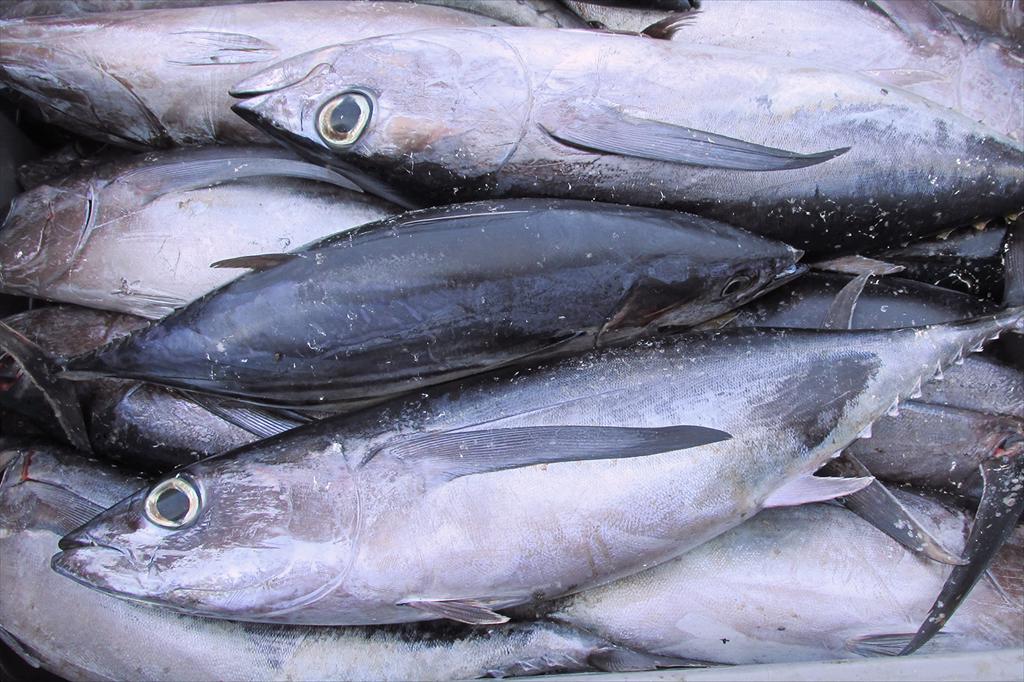
Slower demand in the US and EU weighs on overall exports
According to Vietnam Customs data, monthly export performance shows that after posting growth in January, tuna exports slowed from February through May. This trend reflects the current reality of the global tuna market: demand recovery remains uneven, while costs and competitive pressures continue to rise.
The United States remains Vietnam’s largest tuna market, generating more than USD 140 million and accounting for over 38% of total export value. However, exports to the US declined by 14% year-on-year. The EU recorded over USD 74 million in imports from Vietnam, down 19%.
These two markets are large enough that even a modest slowdown can significantly affect the industry's overall performance. More importantly, the decline no longer appears to be short-term but increasingly reflects greater caution among importers.
Rising freight rates add pressure on distant markets
Export statistics suggest weaker demand in the US and EU, but another challenge is emerging rapidly: logistics costs.
Since early May, ocean freight rates have risen sharply across major shipping routes, particularly to North America and Europe. This is a highly sensitive issue for tuna exporters, as most shipments to the US, Canada, and the EU involve long transit times, require reliable vessel schedules, and often depend on cold-chain logistics and precise delivery timelines for processors and importers.
When freight costs rise, the impact extends far beyond a few thousand dollars per container. Higher shipping costs increase export prices, erode profit margins, disrupt delivery schedules, and encourage importers to negotiate more aggressively on prices. For tuna products such as frozen loins, pre-cooked tuna, canned tuna, and value-added retail products, exporters often cannot fully pass these additional costs on to customers, forcing them to absorb much of the burden themselves.
Nearby markets emerge as growth buffers
While the US and EU are creating headwinds, several other markets have become important growth buffers for Vietnam’s tuna exports.
Exports to Russia reached USD 23 million, up 67% year-on-year. Israel increased by more than 21%, Egypt by over 50%, the Philippines by 18%, and the UAE by more than 32%. Exports to the Middle East rose 16.7%, while shipments to CPTPP markets increased 8.8%.
These figures indicate that Vietnam’s tuna industry is no longer entirely dependent on a handful of traditional destinations. Russia, the Middle East, North Africa, and several CPTPP markets are helping sustain export momentum, particularly as companies seek markets with stronger demand and lower logistics pressures than distant destinations.
Although these markets cannot fully replace the US or the EU, they are clearly playing a more important role today than they did a few years ago.
The second half of the year will be about market selection, not just finding orders
At this stage, tuna exporters can no longer focus solely on increasing sales volumes at all costs. A reassessment of market strategy is becoming increasingly important.
For companies heavily dependent on the US, Canada, or the EU, elevated freight costs may continue to weigh on profitability. Meanwhile, exporters able to expand sales to Japan, the Middle East, Russia, Egypt, or selected CPTPP markets may be better positioned to withstand current challenges. This is not because these markets are easier, but because the overall risks related to logistics and operating costs are currently more manageable.
The tuna industry enters a new phase of market selection
The first five months of 2026 suggest that Vietnam’s tuna industry is not facing a sharp downturn, but it is entering a more pronounced period of market selection and adjustment.
Major markets are no longer as accessible as before. Rising ocean freight rates are increasing costs and widening the competitive gap among suppliers. In this environment, companies that continue to pursue a broad, unfocused sales strategy are likely to face greater pressure.
In the second half of 2026, the key question for Vietnam’s tuna industry will not simply be how much it can export, but where it exports, which products it sells, and at what cost.
(vasep.com.vn) Markets are changing faster, buyer requirements are becoming more demanding, and trade barriers are growing increasingly complex. In this environment, seafood businesses need more than an understanding of current market conditions. They need a longer-term perspective to answer a critical question: Where will growth opportunities come from in 2027–2029, and what should businesses do now to prepare? This is one of the key reasons why VASEP is organizing Vietnam Seafood Summit 2026.
(vasep.com.vn) In the first eight months of 2026, Vietnam’s pangasius exports to the Middle East reached US$113 million, up 7% year on year from the same period in 2025. Growth has become more pronounced in recent months. In August alone, exports to the region totaled US$20 million, an increase of 24%. This indicates that demand for Vietnamese pangasius in the Middle East is gradually recovering after a slowdown in March, although the pace of recovery varies across markets.
(vasep.com.vn) China’s shrimp imports continued to grow strongly in 2026, while Vietnam’s shrimp exports to the market also recorded notable growth. However, behind these positive figures lie two distinct trends: Chinese consumption is growing more slowly than imports, and lobster accounts for a substantial share of Vietnam’s shrimp exports to China, making its product mix significantly different from those of Ecuador and India. Exporters therefore need to assess each segment carefully to understand the opportunities and risks.
(vasep.com.vn) Changing markets, shifting buyer demand, and increasingly complex trade barriers are raising a key question for Vietnam’s seafood industry: Where will the new growth opportunities lie in 2027–2029?
(seafood.vasep.com.vn) As of the end of August 2026, Vietnam’s tilapia exports to the United States reached $21 million, representing a steep 48% year-over-year decline and accounting for 23% of the country's total tilapia export turnover. Frozen fillets accounted for 78% with the remainder consisting of whole frozen tilapia and frozen cuts.
(seafood.vasep.com.vn) After a volatile first half of the year, Vietnam’s pangasius exports to Brazil registered robust growth in July and August 2026. In August alone, export turnover reached $19 million, surging 73% compared to the same period in 2025. Cumulatively for the first eight months, total export value reached $124 million, reflecting an 8% year-over-year increase.
(seafood.vasep.com.vn) Besides modifying their boats, many fishermen in Dak Lak province are making efforts to venture out to sea to harvest seafood during the rough sea season.
(seafood.vasep.com.vn) At the Responsible Seafood Summit and TCRS Shrimp Summit 2026, organized by the GSA (Global Seafood Alliance) in Bangkok, Thailand, the conversation about the future of the shrimp industry began with one of its most important foundations: seedstock quality.
(seafood.vasep.com.vn) In the first eight months of 2026, Vietnam’s tuna exports to Lithuania surpassed $14 million, up 8% year on year. While the increase remains modest, it is notable given the continued pressure on Vietnamese tuna exports to the EU as a whole. More importantly, export turnover to Lithuania has shown a clearer recovery in recent months, making the market a destination worth monitoring for Vietnamese businesses in Europe.
(seafood.vasep.com.vn) Vietnam’s squid and octopus exports exceeded $527 million in the first eight months of 2026, marking a 15% year-on-year increase. This growth is particularly notable given the strong baseline established in 2025, when export turnover for the same period reached $458 million, a 13% rise from 2024.
VASEP - HIỆP HỘI CHẾ BIẾN VÀ XUẤT KHẨU THỦY SẢN VIỆT NAM
Chịu trách nhiệm: Ông Nguyễn Hoài Nam - Phó Tổng thư ký Hiệp hội
Đơn vị vận hành trang tin điện tử: Trung tâm VASEP.PRO
Trưởng Ban Biên tập: Bà Phùng Thị Kim Thu
Giấy phép hoạt động Trang thông tin điện tử tổng hợp số 138/GP-TTĐT, ngày 01/10/2013 của Bộ Thông tin và Truyền thông
Tel: (+84 24) 3.7715055 – (ext.203); email: kimthu@vasep.com.vn
Trụ sở: Số 7 đường Nguyễn Quý Cảnh, Phường An Phú, Quận 2, Tp.Hồ Chí Minh
Tel: (+84) 28.628.10430 - Fax: (+84) 28.628.10437 - Email: vasephcm@vasep.com.vn
VPĐD: số 10, Nguyễn Công Hoan, Ngọc Khánh, Ba Đình, Hà Nội
Tel: (+84 24) 3.7715055 - Fax: (+84 24) 37715084 - Email: vasephn@vasep.com.vn