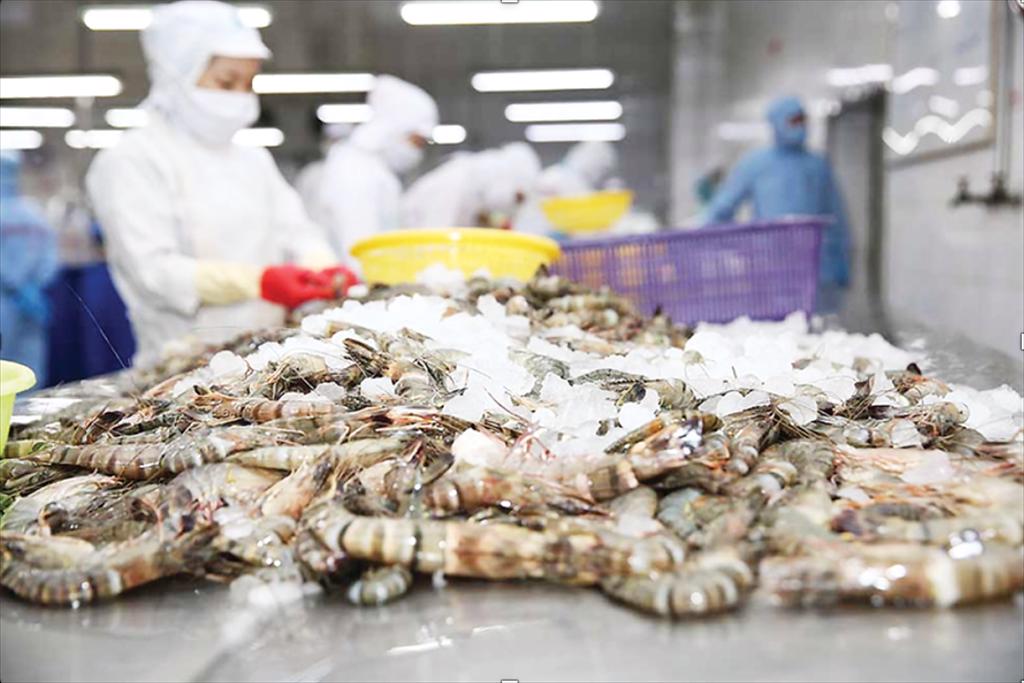
Shrimp exports to Australia maintain an upward trend over five years
From 2021 to 2025, Vietnam’s shrimp exports to Australia generally sustained an upward trajectory, despite cyclical market fluctuations. In 2021, export value reached approximately USD 188 million. In 2022, exports surged to USD 271.6 million, supported by post-COVID-19 demand recovery and tariff advantages under free trade agreements such as the CPTPP, AANZFTA, and RCEP.
In 2023, export value declined to around USD 233 million due to global inflation and weakened seafood consumption across multiple markets. However, the period from 2024 to 2025 saw a recovery, with exports reaching USD 254.3 million in 2025, indicating gradually stabilizing demand in the Australian market.
Australia is currently among the top five importers of Vietnamese shrimp, accounting for about 7–8% of the country’s total shrimp export value.
This growth trend has continued into early 2026. In the first two months of the year, Vietnam’s shrimp exports to Australia reached USD 35.3 million, up 2% year-on-year.
Vietnam remains the largest shrimp supplier to Australia
According to international trade data, Australia has strong import demand for shrimp due to limited domestic supply. Total shrimp imports increased from USD 317 million in 2021 to USD 360.5 million in 2025, with some fluctuations driven by consumption cycles and inventory levels.
Vietnam is the largest shrimp exporter to Australia, accounting for approximately 65–70% of the market’s total import value.
Competing suppliers such as Thailand, China, Malaysia, and Indonesia have significantly smaller shares. Thailand typically ranks second with around USD 45–57 million annually, mainly in processed shrimp, while China and Malaysia hold relatively minor shares.
Australia’s relatively high dependence on Vietnamese shrimp reflects the competitive advantages of Vietnam’s shrimp industry, particularly in processed and value-added segments.
Stable demand and favorable consumption trends
Australia is a high-income market with strong demand for healthy food. Seafood in general—and shrimp in particular—is considered a healthy source of protein, resulting in relatively stable consumption.
Although Australia’s population is only around 25–26 million, per capita shrimp consumption averages about 1.5 kg per year, generating substantial import demand. Consumers are increasingly favoring convenient, value-added products such as cooked shrimp, breaded shrimp, and ready-to-cook items suited to modern retail and foodservice channels.
In terms of product structure, whiteleg shrimp dominates, accounting for approximately 93–96% of total export value to Australia.
Products such as peeled shrimp (PD/PDTO), cooked shrimp (Cooked-RTE), and breaded shrimp are gaining a growing share, reflecting the market’s preference for convenience products.
Stringent requirements that create competitive advantages
One notable feature of the Australian market is its strict biosecurity and food safety system. Imported shrimp must comply with rigorous regulations on disease control, traceability, and food safety as required by Australian quarantine authorities.
While these requirements pose technical barriers, they also help protect the market from lower-standard suppliers. For Vietnamese exporters accustomed to international standards, this can be an advantage in maintaining their market position.
Opportunities to further develop the Australian market
Prolonged tensions in the Middle East are increasing risks along key shipping routes such as Bab-el-Mandeb and the Strait of Hormuz, forcing vessels to take longer detours. This leads to higher transportation, logistics, and fuel costs, as well as extended delivery times. Export routes to the U.S. and EU are also affected, impacting pricing and trade planning.
In this context, expanding into stable markets like Australia is becoming increasingly important for Vietnam’s shrimp industry.
With its position as the leading shrimp supplier to Australia, Vietnam still has significant room to expand its market share, particularly in processed and value-added segments.
Amid growing global trade uncertainty, strengthening stable markets like Australia, while diversifying export destinations, will be key for Vietnam’s shrimp industry to sustain growth and mitigate risks from geopolitical disruptions worldwide.
(seafood.vasep.com.vn) With continued policy support, technological innovation and close coordination among authorities, businesses and farmers, Vietnam’s pangasius industry is expected to make a strong and sustainable breakthrough during the 2026–2030 period, reinforcing its position as the world’s leading exporter of the fish.
(seafood.vasep.com.vn) During the first four months of 2026, Vietnam’s tilapia exports to Asian markets showed varying trends across regions and countries. The Middle East recorded strong growth, with Saudi Arabia emerging as the largest Asian market for Vietnamese tilapia. ASEAN markets also expanded significantly, driven primarily by Malaysia. Meanwhile, Japan maintained solid growth, while exports to South Korea declined compared to the same period in 2025.
(seafood.vasep.com.vn) Shrimp and pangasius continued to lead growth, helping seafood exports reach $4.67 billion in the first five months of the year; however, differentiation among product groups and increasingly stringent requirements from importing markets are posing many challenges for the industry.
(seafood.vasep.com.vn) Every day, the seafood processing industry in Ca Mau generates large quantities of shrimp heads and shells during processing operations. In the past, these by-products were largely treated as waste, increasing production costs and posing potential environmental risks. However, thanks to advanced processing technologies, materials once considered waste are now being transformed into high-value products, creating a circular economy model within the seafood industry.
(seafood.vasep.com.vn) Vietnam Clean Seafood Corporation has invested in a 280-hectare super-intensive shrimp farming zone in Tran De Commune, Can Tho City, generating export value of approximately VND 3 billion per hectare per year—around 50 times higher than traditional agricultural production.
(vasep.com.vn) Vietnam’s seafood exports reached USD 1.02 billion in May 2026, up 0.6% year-on-year. Cumulative exports in the first five months of 2026 totaled USD 4.67 billion, an increase of 11% compared to the same period in 2025.
(seafood.vasep.com.vn) In a rapidly changing global seafood market, timely insights and reliable data are more critical than ever. The Report on Vietnam Seafood Exports in Q1/2026 provides a comprehensive overview of the latest developments in Vietnam’s seafood production, trade performance, and export trends, helping businesses navigate uncertainty and identify new growth opportunities.
(seafood.vasep.com.vn) While many major markets continue to experience slow growth, Russia has emerged as a brighter destination for Vietnamese tuna exports in early 2026. Export turnover to this market increased by nearly 55% in the first four months of the year, indicating a clear improvement in demand. Nevertheless, Russia remains a market that should be viewed with both optimism and caution.
(seafood.vasep.com.vn) Vietnam’s pangasius exports have shown encouraging signs of recovery in 2026. In the first four months of the year, total export turnover reached USD 720 million, up 17% compared to the same period last year. This result reflects improving demand across many markets, as well as the efforts of Vietnamese pangasius enterprises to maintain production, secure orders, and adapt to changing market conditions.
(seafood.vasep.com.vn) In the first four months of 2026, Vietnam’s tilapia exports reached USD 49 million, up 151% compared to the same period in 2025. This impressive growth reflects positive momentum in the tilapia sector, with Brazil emerging as a key driver of growth, while frozen tilapia fillets continued to be the industry's leading export product.
VASEP - HIỆP HỘI CHẾ BIẾN VÀ XUẤT KHẨU THỦY SẢN VIỆT NAM
Chịu trách nhiệm: Ông Nguyễn Hoài Nam - Phó Tổng thư ký Hiệp hội
Đơn vị vận hành trang tin điện tử: Trung tâm VASEP.PRO
Trưởng Ban Biên tập: Bà Phùng Thị Kim Thu
Giấy phép hoạt động Trang thông tin điện tử tổng hợp số 138/GP-TTĐT, ngày 01/10/2013 của Bộ Thông tin và Truyền thông
Tel: (+84 24) 3.7715055 – (ext.203); email: kimthu@vasep.com.vn
Trụ sở: Số 7 đường Nguyễn Quý Cảnh, Phường An Phú, Quận 2, Tp.Hồ Chí Minh
Tel: (+84) 28.628.10430 - Fax: (+84) 28.628.10437 - Email: vasephcm@vasep.com.vn
VPĐD: số 10, Nguyễn Công Hoan, Ngọc Khánh, Ba Đình, Hà Nội
Tel: (+84 24) 3.7715055 - Fax: (+84 24) 37715084 - Email: vasephn@vasep.com.vn