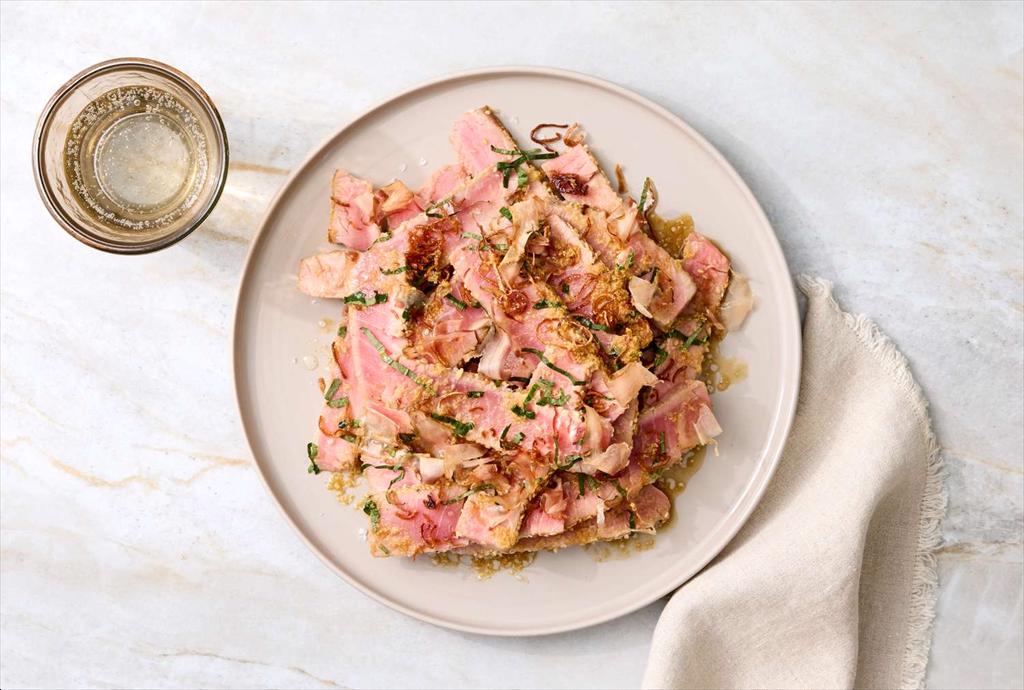
Tuna Exports to the UK Recover in Early 2026
According to Vietnam Customs statistics, Vietnam’s tuna exports to the UK in the first four months of 2026 reached USD 3 million, up nearly 17% compared to the same period in 2025. Monthly export performance fluctuated, but the overall trend still pointed upward.
Vietnamese Tuna Moves Against the UK’s Import Trend
More notably, Vietnam’s growth came at a time when the UK’s overall tuna imports from global suppliers were declining. According to data from the International Trade Centre (ITC), in the first two months of 2026, the UK imported USD 82 million worth of tuna from the world, down 19% year-on-year.
Many major suppliers also saw exports to the UK decline, including Ecuador down 14%, Spain down 41%, Thailand down 27%, and the Philippines down 31%. In contrast, Vietnam’s exports surged by 166%, from USD 846,000 to USD 2.25 million. This indicates that Vietnamese tuna is outperforming the broader market trend and gaining a larger share within the UK’s import structure.
Competition in the UK Remains Intense
This export growth does not mean the UK market has become easier. The UK remains a highly competitive market. In the UK’s import structure for early 2026, Ecuador remained the largest supplier, followed by Mauritius, Ghana, Peru, Spain, and Thailand. These competitors have long-established positions, stable supply chains, and strong presence within the UK distribution system.
For Vietnam, the current growth is an encouraging signal, but turning it into sustained momentum will require more than just a few months of strong increases.
UK Tuna Demand Remains Fundamentally Strong
From a market perspective, tuna still holds a solid position in the UK. According to Seafish’s 2025 report, UK seafood imports increased in both volume and value, supported by supplies of tuna, Alaska pollock, and warm-water shrimp. Tuna was among the key product groups driving seafood import growth.
Moreover, consumer demand in the UK remains relatively stable for convenient seafood products. Tuna accounts for 69% of canned seafood choices among UK consumers. In 2024, tuna ranked third in UK seafood retail sales, after salmon and cod.
This is an important detail because it shows that the UK is not merely a short-term opportunity, but rather a market with well-established consumption demand for canned tuna, ready-to-eat products, sandwiches, and quick meals.
Tariff Advantages Open More Opportunities for Vietnamese Tuna
For Vietnamese exporters, opportunities also come from tariff advantages. The UK officially joined the CPTPP on December 15, 2024, and the agreement took effect between the UK and Vietnam from that date. Together with the UKVFTA, this provides Vietnamese products with improved market access advantages.
For canned and packaged tuna, the UKVFTA maintains a tariff-rate quota mechanism of 11,500 metric tons per year eligible for 0% duty. Beyond the quota, the base tariff rate of 20.5% will gradually decline according to the agreed roadmap.
However, tariff preferences do not automatically translate into orders. The UK market currently favors suppliers capable of ensuring stable deliveries, competitive pricing, and products aligned with convenient consumption trends. Ecuador remains very strong due to its large supply base, while Mauritius and Ghana continue to maintain high positions thanks to well-established supply chains.
Therefore, if Vietnamese companies want to gain additional market share, they will need not only to leverage the UKVFTA and CPTPP, but also to focus on the right segments: frozen tuna, tuna loins, canned tuna, and convenient processed products rather than spreading resources too broadly.
In the short term, Vietnam’s tuna exports to the UK are expected to maintain growth momentum, especially as the country continues expanding its market share while the UK’s overall tuna imports decline.
(seafood.vasep.com.vn) Although Germany’s tuna imports have declined, Vietnam’s tuna exports to the market continue to show positive signs. Notably, export value recovered strongly in Q3/2026, and German import data also show Vietnamese products strengthening their position amid competition among suppliers.
(seafood.vasep.com.vn) Seafood exports are holding double-digit growth, but the opportunities are not spread evenly across product groups and markets. As businesses draw up their plans for 2027, Vietnam Seafood Summit 2026 (VSS2026) offers a chance to look ahead together: what to sell, where to sell it, and how to prepare for growth in the coming years.
(seafood.vasep.com.vn) With less than two weeks to go, the Vietnam Seafood Summit 2026 (VSS 2026) will officially take place in Can Tho. Under the theme “Seafood Market Outlook 2027–2029 – Opportunities and Potential for Double-Digit Export Growth,” the Summit is organized by VASEP at a time when seafood businesses are facing rapid market shifts, changing buyer demand, trade policy changes and growing competitive pressure all at once.
(seafood.vasep.com.vn) On October 28, 2026, the China Fisheries & Seafood Expo opened in Qingdao, China. The expo takes place over three days from October 28 to 30, 2026. This is a prestigious specialized seafood exhibition organized annually by Sea Fare Exposition Inc.
(vasep.com.vn) In the first nine months of 2026, Vietnam’s tilapia exports to the CPTPP bloc reached $7 million, marking a 51% year-on-year increase. The bloc rstands as the fourth-largest market for Vietnamese tilapia, trailing Brazil, the US, and Saudi Arabia.
(vasep.com.vn) VASEP has officially announced the program for Vietnam Seafood Summit 2026 (VSS 2026), featuring five in-depth sessions covering industry outlooks, trade barriers, buyer demand, the domestic market, and solutions to improve productivity and reduce costs across the seafood value chain.
(vasep.com.vn) Vietnam’s shrimp exports reached US$3.7 billion in the first nine months of 2026, up 11% year on year. Although growth has been supported by China and several markets within the CPTPP, momentum is slowing as exports to the United States and the European Union decline. Tariff pressures, international competition, and raw material challenges are creating significant hurdles for exporters in the final months of the year.
(vasep.com.vn) Markets are changing faster, buyer requirements are becoming more demanding, and trade barriers are growing increasingly complex. In this environment, seafood businesses need more than an understanding of current market conditions. They need a longer-term perspective to answer a critical question: Where will growth opportunities come from in 2027–2029, and what should businesses do now to prepare? This is one of the key reasons why VASEP is organizing Vietnam Seafood Summit 2026.
(vasep.com.vn) In the first eight months of 2026, Vietnam’s pangasius exports to the Middle East reached US$113 million, up 7% year on year from the same period in 2025. Growth has become more pronounced in recent months. In August alone, exports to the region totaled US$20 million, an increase of 24%. This indicates that demand for Vietnamese pangasius in the Middle East is gradually recovering after a slowdown in March, although the pace of recovery varies across markets.
(vasep.com.vn) China’s shrimp imports continued to grow strongly in 2026, while Vietnam’s shrimp exports to the market also recorded notable growth. However, behind these positive figures lie two distinct trends: Chinese consumption is growing more slowly than imports, and lobster accounts for a substantial share of Vietnam’s shrimp exports to China, making its product mix significantly different from those of Ecuador and India. Exporters therefore need to assess each segment carefully to understand the opportunities and risks.
VASEP - HIỆP HỘI CHẾ BIẾN VÀ XUẤT KHẨU THỦY SẢN VIỆT NAM
Chịu trách nhiệm: Ông Nguyễn Hoài Nam - Phó Tổng thư ký Hiệp hội
Đơn vị vận hành trang tin điện tử: Trung tâm VASEP.PRO
Trưởng Ban Biên tập: Bà Phùng Thị Kim Thu
Giấy phép hoạt động Trang thông tin điện tử tổng hợp số 138/GP-TTĐT, ngày 01/10/2013 của Bộ Thông tin và Truyền thông
Tel: (+84 24) 3.7715055 – (ext.203); email: kimthu@vasep.com.vn
Trụ sở: Số 7 đường Nguyễn Quý Cảnh, Phường An Phú, Quận 2, Tp.Hồ Chí Minh
Tel: (+84) 28.628.10430 - Fax: (+84) 28.628.10437 - Email: vasephcm@vasep.com.vn
VPĐD: số 10, Nguyễn Công Hoan, Ngọc Khánh, Ba Đình, Hà Nội
Tel: (+84 24) 3.7715055 - Fax: (+84 24) 37715084 - Email: vasephn@vasep.com.vn