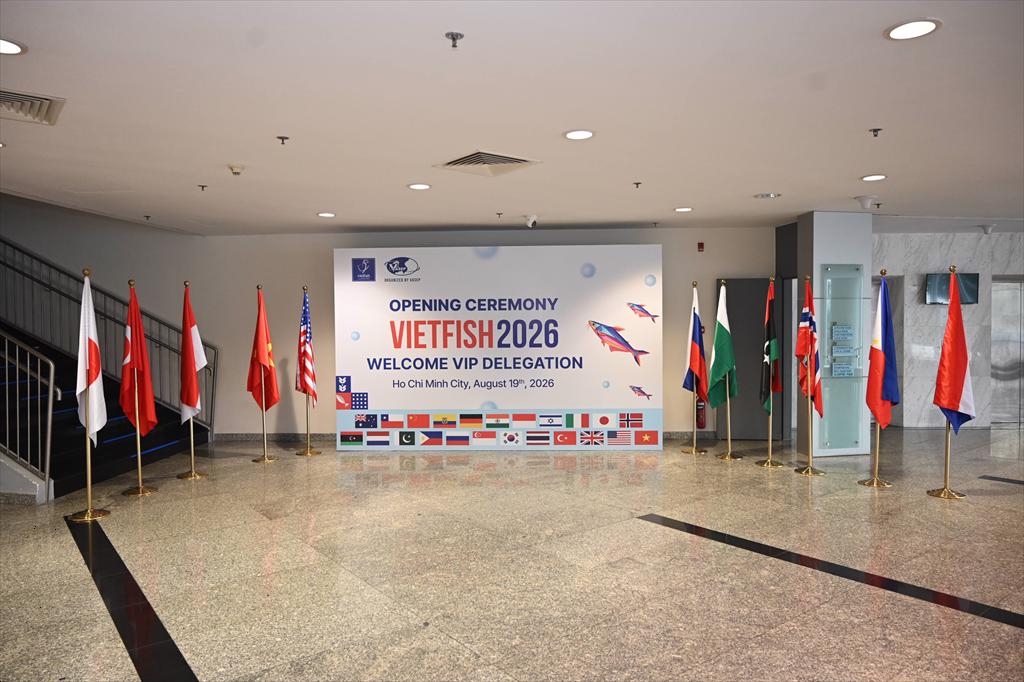
From “Asia’s Leading Seafood Meeting Point” to a Launchpad for New Contracts and Connections
From FAO GLOBEFISH and SeafoodSource to media and organizations from Norway, Türkiye, Russia, Japan, and South Korea, international stakeholders viewed VIETFISH from different perspectives: as a sourcing hub, a platform for showcasing technology, a gateway to new markets, a venue for knowledge exchange, and a place where new partnerships and business contracts can begin.
These perspectives show that VIETFISH 2026 is becoming more than a seafood exhibition in Vietnam. It is increasingly recognized internationally as a practical gateway to Vietnam’s seafood value chain and the wider Asian market.
“A leading seafood trade show in Asia”
For its first participation in VIETFISH, FAO GLOBEFISH described VIETFISH as “a leading seafood trade show in Asia.”
FAO GLOBEFISH’s first presence at VIETFISH went beyond exhibition activities. The organization shared insights into issues shaping global seafood trade, including market trends, new supply-chain requirements, attracting younger generations to the seafood sector, and preventing seafood fraud.
From Türkiye’s perspective, TurkishAgriNews noted that VIETFISH continues to demonstrate its role as one of the most important meeting points for the seafood value chain in Asia.
The publication highlighted the exhibition’s scale, with 335 companies, 568 booths, participants from 17 countries and territories, and nearly 15,000 visitors. More importantly, however, Turkish stakeholders were particularly interested in the quality of business meetings and VIETFISH’s potential as a starting point for entering Vietnam and neighboring Southeast Asian markets.
Meanwhile, South Korea’s MyFair introduced VIETFISH as one of Southeast Asia’s leading seafood industry exhibitions and a “real-world testing ground” for Korean companies seeking access to Asia’s seafood processing and export markets.
This perspective demonstrates that VIETFISH’s appeal comes not only from its scale, but also from Vietnam’s strategic position within the region’s seafood processing, trade, and consumption network.
More than seafood: Connecting technology and knowledge
Norway’s participation at VIETFISH 2026 received particular attention from ScandAsia.
According to ScandAsia, the Norwegian delegation came to VIETFISH not only to showcase salmon and seafood products. The Norwegian pavilion brought together 11 companies and organizations covering multiple links in the aquaculture value chain, including genetics, fish health, feed, farming equipment, processing automation, and waste reduction.
ScandAsia noted that this participation demonstrates that cooperation between Norway and Vietnam is not simply about seafood trade, but also about technology, knowledge, and equipment that can help Vietnam’s aquaculture and seafood processing sectors become more efficient and sustainable.
Direct feedback from participating companies also reflected the strong networking atmosphere at the exhibition. On LinkedIn, Benchmark Genetics described its first day at VIETFISH as “busy and rewarding,” with a large number of visitors engaging at the Norwegian pavilion. The company particularly highlighted the meetings, discussions, and new connections established during the event.
For the Global Seafood Alliance, participation in VIETFISH was also closely linked to BAP standards, responsible aquaculture development, and meeting increasingly stringent requirements across global supply chains.
These responses demonstrate that VIETFISH 2026’s “Innovation and Sustainability” theme went beyond a slogan. The exhibition became a platform where solutions in genetics, feed, aquatic animal health, animal welfare, automation, by-product utilization, and emissions reduction could connect directly with the needs of Vietnamese businesses.
From meetings to first contracts
One of the most notable responses came from Russia.
The information channel of the All-Russian Association of Fishery Enterprises – VARPE described VIETFISH as Vietnam’s largest seafood exhibition and one of the leading events in Southeast Asia.
2026 marked the first participation of Russian fishing companies in the exhibition and business activities at VIETFISH. Tikhrybkom Magadan Seafood introduced its Nord Mile brand and premium wild-caught seafood products.
Notably, the Russian company reported that it met new partners and signed its first contracts during the exhibition.
The Russian side also noted strong interest from Vietnamese partners in developing value-added and premium semi-finished products incorporating crab and other wild-caught seafood.
For the Turkish delegation, VIETFISH 2026 was also its first participation. Eight exporting companies from the Eastern Black Sea Exporters Association showcased Turkish salmon, fishmeal, fish oil, sea snails, and aquafeed.
According to TurkishAgriNews, the high frequency of B2B meetings helped companies establish new commercial relationships and explore cooperation opportunities in Vietnam and neighboring Asian markets. For the Turkish side, VIETFISH was not simply a successful exhibition, but an important starting point for building long-term brand recognition and commercial relationships in Vietnam and Southeast Asia.
These results provide an important measure of the exhibition’s impact: VIETFISH not only generates visitor traffic but also directly creates contracts, partnerships, and new product development opportunities.
VIETFISH becomes a source of stories about Vietnam’s seafood industry
International trade media did more than report on the opening ceremony and exhibition scale. Several media outlets used VIETFISH as an opportunity to meet businesses directly and explore new business stories emerging from Vietnam’s seafood sector.
At VIETFISH 2026, SeafoodSource interviewed Vinh Hoan’s CEO about opportunities to expand Vietnamese pangasius in Europe amid tightening supplies and rising prices of other whitefish species. The article examined prospects in Spain, the UK, and Germany, while also covering raw materials, feed, labor, and automation challenges facing Vietnam’s pangasius industry.
In another article, SeafoodSource reported on An Hai’s doubling of tuna processing capacity, based on direct discussions with the company at VIETFISH. The article not only introduced the new plant’s capacity but also examined markets including the US, EU, Russia, Japan, and South America, as well as increasingly stringent requirements concerning raw materials and traceability.
This demonstrates that VIETFISH is gradually becoming a “news hub” for Vietnam’s seafood industry – a place where international media can access information about production capacity, market strategies, technology, and the outlook for Vietnamese seafood companies.
Vietnam strengthens its position as a global seafood hub
On LinkedIn, Keisho Ka, President and CEO of Japanese refrigeration and air-conditioning trade publication JARN, noted that the opening of VIETFISH 2026, with more than 14,000 m² of exhibition space and 568 booths, demonstrated Vietnam’s strengthening position as a global seafood hub.
JARN stated that it would continue to feature refrigeration technology and seafood processing equipment companies participating in VIETFISH in its regular and special refrigeration industry publications.
In Malaysia, The Star chose the headline: “Vietfish expo drives Vietnam seafood industry towards higher value, sustainability.”
A common message emerges across these international perspectives: Vietnam’s seafood industry is shifting from competing primarily on volume and cost toward quality, technology, value-added processing, branding, and supply-chain sustainability.
And VIETFISH is where this transformation is being brought together most visibly.
From a Vietnamese exhibition to an international connection platform
With 335 companies, 568 booths, participants from 17 countries and territories, and nearly 15,000 visitors, VIETFISH 2026 was the largest edition in the exhibition’s history in terms of scale and attendance.
But from the perspective of international organizations, media, and businesses, the value of VIETFISH goes beyond these numbers.
FAO GLOBEFISH chose VIETFISH for the first time to share insights into global seafood challenges; Norway brought an ecosystem of technology rather than simply showcasing products; a Russian company signed its first contracts; Turkish salmon found opportunities to enter Vietnam and Southeast Asia; while US and Japanese media came to VIETFISH to explore new stories about Vietnamese seafood businesses and technology.
The world is increasingly viewing VIETFISH as a meeting point connecting supply, markets, technology, standards, knowledge, and consumers.
VIETFISH 2026 may have come to an end, but the contracts, partnerships, and stories that emerged from three days of the exhibition will continue to develop – alongside Vietnam’s journey toward greater value and a stronger position on the global seafood map.
(seafood.vasep.com.vn) On October 31, 2026, in Hanoi, Sa Giang Import-Export Corporation, a member of the Vietnam Association of Seafood Exporters and Producers (VASEP), was awarded the Top 30 Outstanding Cultural and Reputable Enterprises of 2026 certificate by the Vietnam Chamber of Commerce and Industry (VCCI). This group represents the most distinguished companies among the 100 enterprises honored at the “Cultural and Reputable Enterprises 2026” announcement ceremony.
(vasep.com.vn) In the first nine months of 2026, Vietnam’s pangasius exports to the EU reached approximately $148 million, up 12% compared to the same period in 2025. In September 2026 alone, export turnover to this market hit $18 million, a 27% year-on-year increase. Despite diverging demand across member states, the EU remains a market with growth potential for Vietnamese pangasius, particularly as supplies of several traditional whitefish species face mounting pressure.
(seafood.vasep.com.vn) Vietnam’s tuna exports to the US are showing a clear recovery after a difficult start to the year. However, the rebound is taking place against a backdrop of declining US tuna imports and a shifting supply structure, posing new challenges for Vietnamese businesses.
(vasep.com.vn) In the first nine months of 2026, Vietnam’s shrimp exports to Japan reached US$440.9 million, up 6.4% year on year. This result is noteworthy as Japan’s total shrimp imports continued to decline slightly and competition among suppliers intensified. Demand for convenience foods and processed products continues to create opportunities for Vietnamese exporters, but capitalizing on these opportunities requires stronger competitiveness and the ability to meet increasingly specific market requirements.
(vasep.com.vn) After slowing in the first months of the year, Vietnam’s tuna exports have shown a clear improvement since June 2026. However, behind September’s double-digit growth lies a notable reality: export value is recovering, but pressures from markets, trade policies, and competition among suppliers remain.
(vasep.com.vn) Vietnam’s pangasius export value reached US$1.7 billion in the first nine months of 2026, up 11% year on year. In September alone, exports totaled US$210 million, an increase of 16%. China, the United States, and Brazil were the three largest markets, accounting for 49% of total export value. While China and Brazil maintained their growth momentum, exports to the US remained below the level recorded in the same period last year.
(vasep.com.vn) On November 11, 2026, in Can Tho, the Vietnam Association of Seafood Exporters and Producers (VASEP) will organize the Vietnam Seafood Summit 2026 (VSS 2026) under the theme “Seafood Market Outlook 2027–2029: Opportunities and Headroom for Double-Digit Export Growth.”
(seafood.vasep.com.vn) Business leader Do Ngoc Tai, General Director of Tai Kim Anh Seafood Processing Joint Stock Company, was honored by the Vietnam Chamber of Commerce and Industry (VCCI) with the title “Outstanding Vietnamese Entrepreneur – Thanh Giong Cup 2026” at a ceremony celebrating Vietnam Entrepreneurs’ Day (October 13). The event took place on the evening of October 11, 2026, at the National Convention Center in Hanoi.
(vasep.com.vn) The global tilapia market is becoming increasingly segmented, not only among producing countries but also by product type and destination market. Supply is divided into groups with distinct competitive advantages: large volumes of whole fish and frozen fillets from Asia, high-value fresh fillets from Latin America, and substantial domestic consumption in several major producing countries.
(vasep.com.vn) Vietnam’s tuna exports to the UK grew in the first eight months of 2026, despite signs of slowing import demand in the market. However, sharp fluctuations in orders, competition from major suppliers, and new traceability requirements are creating challenges for Vietnamese exporters.
VASEP - HIỆP HỘI CHẾ BIẾN VÀ XUẤT KHẨU THỦY SẢN VIỆT NAM
Chịu trách nhiệm: Ông Nguyễn Hoài Nam - Phó Tổng thư ký Hiệp hội
Đơn vị vận hành trang tin điện tử: Trung tâm VASEP.PRO
Trưởng Ban Biên tập: Bà Phùng Thị Kim Thu
Giấy phép hoạt động Trang thông tin điện tử tổng hợp số 138/GP-TTĐT, ngày 01/10/2013 của Bộ Thông tin và Truyền thông
Tel: (+84 24) 3.7715055 – (ext.203); email: kimthu@vasep.com.vn
Trụ sở: Số 7 đường Nguyễn Quý Cảnh, Phường An Phú, Quận 2, Tp.Hồ Chí Minh
Tel: (+84) 28.628.10430 - Fax: (+84) 28.628.10437 - Email: vasephcm@vasep.com.vn
VPĐD: số 10, Nguyễn Công Hoan, Ngọc Khánh, Ba Đình, Hà Nội
Tel: (+84 24) 3.7715055 - Fax: (+84 24) 37715084 - Email: vasephn@vasep.com.vn